


The Productivity Paradox
Over the past two decades, enterprises have invested billions of dollars into RPA, workflow engines, low-code platforms, and, more recently, generative AI. However, despite this historic push for automation, enterprise productivity gains have often been uneven and incremental. While these technologies have reduced manual effort and accelerated analysis, broader productivity metrics have remained stubbornly flat, in large part because the underlying flow of work has been left unchanged. As a result, organizations still rely on humans to navigate fragmented systems, manage handoffs, and coordinate decisions across functions, effectively shifting the burden from execution to orchestration.
Generative AI (GenAI) makes this gap between intelligence and impact explicit: it delivers faster information, but the orchestration and follow-through required to achieve outcomes remain human-dependent. Awareness of Gen AI is high, yet a global study conducted in late 2025 of ~50,000 workers shows only 14% (1) use GenAI daily, and when they do, it is typically to perform peripheral tasks such as drafting documents or answering questions, rather than being integrated into end-to-end workflows that drive business results. Insights now arrive quickly, but humans still translate intent into actions, manage dependencies, and ensure decisions produce measurable outcomes. The constraint is no longer intelligence; it is the coordination required to move from request to completed work. This whitepaper outlines how Agentic AI can directly address this gap by embedding intelligence into execution, turning insights into coordinated action at enterprise scale.
The shift from conversational AI to autonomous agents capable of executing real-world tasks marks a fundamental transformation in enterprise technology. Agentic AI enables autonomous agents to devise solutions, execute them, and adapt dynamically as conditions change to achieve defined goals. For the first time, AI can function as an operational layer: closing loops, resolving dependencies, and progressing work without requiring human orchestration at every step. As a result, the next decade of productivity gains and cost savings will come less from adding tools and more from redesigning work around autonomous, goal-driven agents. With 88% of executives planning to allocate AI budgets to agentic capabilities in the next 12 months, and the market projected to reach ~$200 billion in global revenue by 2034 (2), agentic frameworks have moved from experimental curiosity to business necessity.
From Automation to Autonomous Workflows
Why Traditional Automation Plateaued
First-wave automation was designed for stable, well-defined steps. RPA bots and workflow engines excel when inputs are known, paths are fixed, and exceptions are rare, often delivering 20-40% (3) efficiency gains in targeted processes. However, most enterprise work does not behave that way: information is incomplete, dependencies emerge midstream, and priorities shift. When conditions change, scripted automation typically fails or escalates to humans.
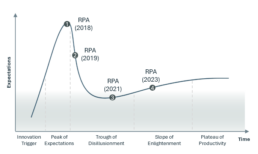
As a result, automation improved local steps but left the overall flow largely unchanged. Humans remained responsible for stitching together context, deciding what should happen next, moving data between systems, and pushing work through decision points. The outcome was faster tasks, but not substantially faster end-to-end resolution. As illustrated in Exhibit 1, RPA experienced a sharp rise in expectations during its initial surge (2018–2019), driven by the belief that automation would rapidly become more cognitive. However, enterprise adoption revealed a different reality: RPA remained largely task-bound, well-suited for predefined, deterministic workflows but limited in its ability to handle ambiguity, manage cross-process dependencies, or adapt to change. These constraints led to a pronounced trough of disillusionment and a subsequent productivity plateau, as RPA delivered incremental efficiency gains without materially accelerating end-to-end outcomes, thereby setting the stage for renewed interest in generative and agentic AI.
Exhibit 1. RPA Productivity Ceiling
Where GenAI & RAG Stalled
GenAI and retrieval-augmented generation (RAG) systems have primarily advanced understanding rather than execution. They make it easier to search documents, summarize policies, and draft content – effectively lowering the cost of “thinking” about work. However, these systems remain largely reactive: they respond to a prompt but stop short of determining the next action, coordinating across tools, or tracking whether work is completed. As a result, insight has improved, while orchestration has not.
This dynamic helps explain why GenAI often boosts individual productivity without fundamentally transforming enterprise workflows. AI can generate summaries or drafts (e.g., contract markups, incident analyses), while humans still handle interpretation, approvals, and system execution. The result is faster inputs into work, but little reduction in the coordination and follow-through that determines how quickly outcomes are delivered.
Agentic AI and Autonomous Workflows
Agentic AI reframes the unit of work from tasks to goals. Instead of automating a step, an agent operates against an outcome such as “resolve this request,” or “close this case.” It starts with intent, breaks it into actions, executes those actions, evaluates results, and adapts as context evolves. If information is missing, it gathers it; if a precondition fails, it reroutes or escalates; progress continues until human judgment is genuinely required.
Value is realized primarily through compressed end-to-end cycle times (and less from faster individual actions). By owning orchestration, reconciling data, validating prerequisites, and driving follow-through, agents eliminate the rework and stalled handoffs that often stretch across workdays.
Autonomy, however, does not mean loss of control. Effective agentic workflows are constrained by policy, operate within defined boundaries, and escalate to humans when approvals, interpretation, or risk decisions are required. Humans retain intent, oversight, and accountability; agents take on the coordination work that previously consumed time without adding insight.
Reducing Organizational Drag
While automation and GenAI accelerate individual tasks, organizational drag – the cumulative friction created by handoffs, status checks, context reconstruction, and cross-system coordination between process steps – continues to slow results. This drag manifests as stalled handoffs, manual escalations, repeated follow-ups, and cross-system lookups to rebuild missing context. Task automation optimizes steps; drag lives in everything around them. The economic impact can be quantified directly:
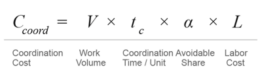
In high-volume workflows, even modest reductions in coordination time per unit compound quickly. A process handling 10,000 cases per month with 30 minutes of avoidable coordination per case at $50/hour labor cost represents $250,000 in monthly drag. Reducing coordination time by 50% yields $125,000 in monthly savings from a single workflow, before accounting for faster cycle times and improved throughput.
The earliest gains appear in high-volume, cross-system flows like ticket triage, reconciliation prep, and case resolution; here, agents track work status across systems, gather missing information, sequence actions, and drive work to completion rather than stopping after a single step. A reconciliation agent, for example, can pull data from multiple sources, match records, flag exceptions, request clarifications, and assemble a near-complete work package for review. Human analysts still apply judgment and approve outcomes, but multi-day delays caused by fragmented systems largely disappear.
One global technology company found that after deploying agentic AI in its service desk, its virtual agent was able to resolve 65% (4) of initial customer contacts without human intervention, fundamentally changing how human agents are staffed and utilized. In early implementation waves with comparable enterprises, we observed approximately 30% run-rate cost savings across core processes (e.g., batch jobs, reporting, entitlements).
Agentic Workflow Architecture
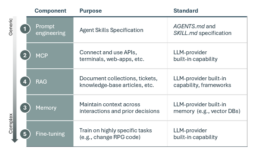
Agentic workflows transform business goals into dynamic execution plans that operate across systems through an orchestrated combination of AI components. This architecture comprises five complementary capabilities (see Exhibits #2 and #3), each serving a distinct function:
1.Prompt Engineering and Agent Design: Defines how agents think and act (e.g., reasoning patterns), translating business intent into clear rules for decision-making, actions, and edge cases.
2.Tool Integration (including MCP): Connects agents to external systems, APIs, databases, and applications. Model Context Protocol (MCP) provides a standardized interface for these connections, enabling agents to interact with diverse tools through a consistent pattern rather than requiring custom integrations for each system.
3.Retrieval-augmented Generation (RAG): Provides contextual grounding by retrieving relevant documentation, knowledge bases, policies, or historical data so agents operate with current, domain-specific information rather than relying solely on training data.
4.Memory and State Management: Enables agents to maintain context across interactions, track progress on long-running workflows, remember prior decisions, and resume work after interruptions. This capability distinguishes agentic systems from stateless chatbots and is essential for multi-step processes that span hours or days.
5.Fine-Tuned and Specialized Models: Supply deep domain expertise through models trained on proprietary or task-specific data. These specialized models work alongside general-purpose LLMs to handle advanced reasoning in areas like legal analysis, financial modeling, or technical diagnostics.
Together, these capabilities enable an AI agent orchestrator to integrate reasoning, context, memory, and execution; agents can adapt, collaborate, and autonomously deliver outcomes across business systems. Exhibit 2 illustrates these key components of agentic AI spanning from generic and simple to complex and specific. Not every solution requires all components; the mix is tailored by use case and level of risk and autonomy.
Exhibit 2. Core Components of Agentic AI Orchestration
Redesigning Work Around Agentic Capabilities
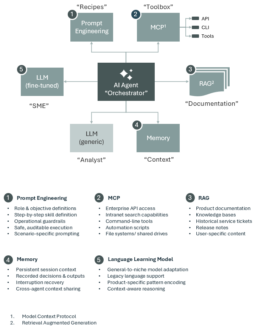
Redesigning work for Agentic AI is not about automating more tasks, but about changing how work is owned and completed. In an agentic model, humans remain responsible for defining outcomes, priorities, and constraints, while agents are responsible for executing and coordinating the work needed to achieve those outcomes across systems. As illustrated in Exhibit 3, a unified orchestration layer, spanning prompts, context, memory, and models, enables agents to act with shared context and clear guardrails.
follow-through, and keeping work moving. As a result, organizations spend far less time on status checks, manual handoffs, and tool-to-tool coordination, and more time on decisions that require human input.
Best-fit early use cases share a pattern: high-volume, rules- or policy-driven workflows spanning multiple systems, where coordination drag, not expert judgment, is the main bottleneck. Examples include IT request resolution, routine customer service cases, finance reconciliations, KYC refresh, supplier onboarding, access provisioning, and policy-driven approvals (e.g., standard discounts or low-risk contract changes). These domains are structured enough to define guardrails yet fragmented enough that humans currently absorb most of the orchestration overhead.
Most organizations do not move directly to full autonomy. Instead, adoption follows a gradual progression as trust, controls, and process clarity increase:
– Assisted: Agents support humans by drafting content or suggesting next actions (e.g., proposed ticket resolutions or response emails).
– Automated: Agents reliably execute well-defined tasks with limited scope (e.g., password resets or simple refunds).
– Augmented: Agents manage most of an end-to-end workflow, with humans providing oversight and handling exceptions (e.g., full IT request resolution with targeted escalation).
– Autonomous: Agents own clearly defined outcomes within explicit boundaries (e.g., from document collection through system setup).
– Multi-agent collaboration: Coordinated agent teams handle complex workflows that span functions. A shared context framework keeps agents aligned—each agent knows what others are doing, which tasks are complete, and when to escalate. This enables organizations to scale agentic workflows across IT, finance, and operations without coordination errors or duplicated effort.
Approximately 66% of agentic AI implementations now use multi-agent system designs, indicating that coordinated, specialized agents have become the dominant approach in advanced deployments. Among the 300+ organizations already deploying AI agents, nearly two-thirds report productivity gains, while over half cite direct cost savings (57%), faster decision-making (55%), or improved customer experience (55%). These outcomes reinforce the business case beyond headline ROI figures, highlighting the value of process redesign enabled by agentic capabilities (5).
Exhibit 3. Standardized, Reusable Components in Agentic AI
Risks, Governance and Responsible Autonomy
As autonomy grows, so does the need for disciplined risk management. Agentic systems introduce unique failure modes, including goal misalignment, tool misuse (such as acting in the wrong environment or on the wrong dataset), hallucinated context, and uncontrolled loops after context changes.
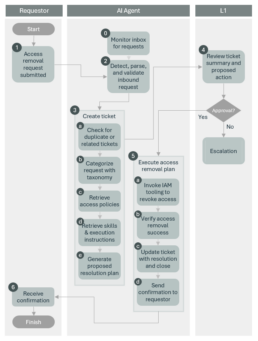
To address these risks, organizations are translating policy into concrete, enforceable guardrails at the agent level, embedded directly into operational workflows such as the access removal process illustrated in Exhibit 4:
These guardrails help ensure that agents operate safely, reliably, and in alignment with organizational policies, while still allowing for scalable, automated decision-making.
– Policy boundaries: Defining what agents do without human approval (e.g., financial thresholds, data access limits, transaction scope).
– Escalation rules: Triggering human review based on confidence scores, dollar amounts, user types, or data sensitivity.
– Simulation and sandboxing: Testing new workflows against synthetic or recorded data before production.
– Circuit breakers: Automatically halting agents when monitoring detects anomalous patterns, unexpected volumes, or conflicting signals, forcing manual review.
Regulators and risk bodies consistently emphasize that AI and agents should fit within model risk management and governance frameworks rather than bypass them. In practice, this means defining clear accountability for agent behavior, maintaining audit trails and explainability, and enforcing segregation of duties even when decisions are automated.
When compliance, risk, and governance teams are involved from the outset, they become enablers of responsible autonomy rather than gatekeepers. Their participation allows organizations to push further along the autonomy curve with confidence, knowing that control and accountability remain intact as orchestration shifts from humans to agents.
Exhibit 4. Sample Process of AI Agents in Access Removal Requests
Agentic Roadmap
Realizing value from Agentic AI requires a structured path that aligns technology, processes, and governance. This begins with a focused diagnostic to quantify coordination drag, map cross-system workflows, and identify policy-constrained segments. The outcome is a prioritized set of attainable opportunities, autonomy boundaries, and risk profiles.
Early adoption favors depth over breadth. Organizations typically pilot one autonomous workflow per major function (e.g., IT, finance, operations, HR) under explicit guardrails. Common starting points include password resets, variance preparation, and standard onboarding. Each pilot incorporates observability, human-in-the-loop controls, and outcome-based metrics (e.g., cycle time, throughput, CSAT) to validate impact and build trust.
Scaling depends on standardization, not custom-made builds. Enterprises institutionalize Agentic AI through reusable agent libraries, domain-specific memory, and shared monitoring infrastructure. At scale, consistent context management becomes as important as model quality. Standardized protocols provide a common way for agents to encode, share, and update context (e.g., goals, task state, and dependencies), enabling predictable multi-agent coordination and reliable expansion across the enterprise.
Organizations that treat Agentic AI as an operating capability, grounded in standardization, shared context, and governance, are best positioned to scale autonomy responsibly and capture sustained productivity gains.
Conclusion
As agentic AI matures, advantage is shifting from tool adoption to enabling seamless flow of work. Traditional automation optimized tasks but left coordination costs largely intact, limiting its value realization. Agentic workflows address this by translating intent into policy-aligned execution, reducing cross-system friction and manual oversight while improving speed, cost, and predictability.
This shift is already underway, with AI agents in production and investment accelerating. For executives, the immediate priorities are straightforward:
1. Quantify your coordination drag. Identify the three to five highest-volume workflows where handoffs, status checks, and cross-system lookups consume the most time relative to actual value-adding work.
2. Run a bounded pilot. Select one workflow per major function, define explicit guardrails and escalation rules, and measure cycle time, throughput, and error rates before and after.
3. Engage governance early. Bring risk, compliance, and security teams into the design process, not as reviewers at the end, but as co-designers of autonomy boundaries.
4. Invest in the platform, not just the pilot. Build reusable components, shared memory infrastructure, and standardized integration patterns that allow pilots to scale without rebuilding from scratch.
Organizations that act first by redesigning high-drag workflows with governance will convert coordination overhead into competitive advantage.
- PWC, Global Workforce Survey, 2025
- Precedence Research, Agentic AI Market Size, 2025
- International Journal of Advanced Computer Science and Applications
- Forrester, AI Centric Service Desk Results, 2025
- PWC, AI Agent Survey, 2025