


Introduction
“ A $20M enterprise deal is up for renewal in 90 days. The champion who signed the contract left six months ago. Product usage has dropped 40% since Q2. The new VP has never seen a value report. Three competing vendors are running POCs on the same floor. The CSM has no idea. The renewal conversation opens with the most dangerous question in SaaS:
“So… tell us what value you’ve delivered?”
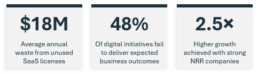
This is the moment most SaaS companies lose – and it is happening at scale (Exhibit 1). The gap between value promised and value delivered is the #1 threat to SaaS growth.
Net Revenue Retention (NRR) – driven by renewals, adoption, and expansion – has emerged as the most critical indicator of long-term SaaS performance.
In this environment, the ability to continuously realize, measure, and communicate customer value is not optional. Value realization has evolved from a customer success activity into a strategic, cross-functional discipline that determines whether SaaS providers retain relevance and revenue over time.
AI is fundamentally reshaping this capability. Predictive analytics, GenAI, and increasingly Agentic AI systems are enabling SaaS providers to reimagine the value they deliver, monitor value metrics, initiate corrective actions, generate insights, and orchestrate workflows across systems without requiring constant human intervention.
Exhibit 1. Value Gap at a Glance
Together, AI and Agentic AI are enabling continuous, intelligent value realization. Most organizations recognize the opportunity, but few have built the infrastructure to realize it.
Today, value from SaaS investments is tracked inconsistently, evidence is assembled reactively, and customer success teams are left to bridge a widening gap between what was promised and what can be proven. AI changes this fundamentally by enabling continuous monitoring, proactive intervention, and automated value evidence at a scale no human team can match. Providers who build this capability will move beyond feature-led selling toward outcome-driven partnerships with their customers.
The framework introduced in this whitepaper is built for autonomous systems, and a dedicated Value Realization Office, it illustrates how AI and Agentic AI can be embedded across the customer lifecycle to drive sustained SaaS growth.
Case for Change
The original promise of SaaS centered on flexibility, rapid deployment, and lower upfront investment. Over time, however, widespread adoption has altered buyer expectations. Customers no longer evaluate SaaS solutions based solely on features or usability; they assess them on their ability to deliver tangible business outcomes, such as productivity gains, cost efficiencies, risk reduction, or strategic enablement.
This shift has profound implications for SaaS economics. In a subscription-based model, value must be delivered continuously – not only during implementation but throughout the customer lifecycle. Renewals, upsells, and cross-sells depend on the ability of vendors to demonstrate tangible outcomes and align their solutions with evolving customer priorities.
However, many SaaS organizations still rely on traditional engagement models in which value is articulated during pre-sales but measured inconsistently after deployment. Business cases are often static documents, value metrics are tracked manually, and customer success teams must interpret fragmented data across systems.
The challenge is amplified by organizational complexity. Customer success teams often manage large account portfolios, product teams lack insight into the drivers of adoption, and sales teams enter renewal discussions without credible evidence of realized value.
These limitations create a critical gap between promised versus realized value.
AI provides the capability to bridge this gap. By continuously analyzing customer signals – product usage, operational metrics, support interactions, and external benchmarks – AI systems enable SaaS providers to monitor realized value in real time and intervene proactively when outcomes diverge from expectations.
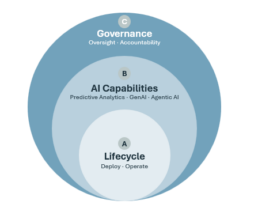
AI-enabled value realization (exhibit 2) operates across three layers: the Value Realization Lifecycle that structures how value is delivered, AI capabilities that generate insights and orchestrate actions, and governance that ensures responsible and controlled execution. Together, these layers enable a shift from manual engagement to a continuous, intelligent value delivery model.
Exhibit 2. Value Realization Model
From Value Promised to Value Realization
Today, providers invest considerable effort in defining value propositions, competitive differentiation, and ROI during the pre-sales phase. While this is necessary, it implicitly assumes that value will naturally emerge once the solution is implemented.
Value realization requires deliberate orchestration across people, processes, and technology. It depends on clearly defined success criteria, effective adoption strategies, continuous monitoring, and consistent communication with stakeholders. Without a structured approach, value realization becomes unreliable and dependent on the capabilities of individual account managers.
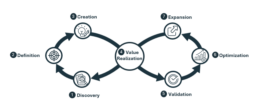
Value realization is therefore not a one-time activity but a discipline. It ensures that customer outcomes are achieved, measured, validated, and expanded over time. The Value Realization Lifecycle provides a structured framework for embedding this discipline across the entire customer journey (Exhibit 3)
Exhibit 3. The Infinite Value Realization Lifecycle Loop
AI-Enabled Value Realization Lifecycle
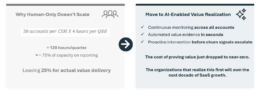
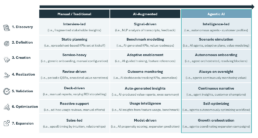
The Value Realization Lifecycle provides the structure for delivering customer outcomes, but traditional execution models do not scale. Most SaaS organizations still rely on a QBR-and-spreadsheet model, where customer success teams manually compile usage data, prepare reports, and assess value periodically. As account portfolios grow, this approach consumes significant capacity and limits visibility into whether value is being realized between review cycles (Exhibit 4).
AI transforms this model by shifting value realization from periodic reporting to continuous intelligence. By analyzing product usage, operational signals, and customer interactions in real time, AI systems can monitor outcomes across the entire customer base and surface risks or opportunities immediately. Agentic AI extends this further by initiating proactive interventions, allowing organizations to detect issues earlier, accelerate adoption, and deliver value consistently at scale.
Exhibit 4. Inflection Points: QBR-and-Spreadsheet Model is Dead
The Value Realization Lifecycle is designed as a closed-loop framework. The lifecycle emphasizes feedback, iteration, and continuous optimization.
When augmented with AI – and increasingly with agentic AI systems that act autonomously on behalf of users – each stage becomes more intelligent, responsive, and scalable.
Stage 1: Value Discovery
The lifecycle begins with understanding the customer’s strategic priorities and success criteria. Traditionally driven by interviews and workshops, discovery often captures fragmented insights. AI improves this stage by synthesizing signals such as product usage, support data, customer feedback, and benchmarks to identify key value drivers and risks. Agentic AI extends this further by continuously maintaining dynamic customer intelligence profiles, turning discovery into an ongoing, data-driven process.
Stage 2: Value Definition
Once priorities are clear, organizations define measurable success metrics and a shared value roadmap. Traditionally, this relies on static business cases and manually defined KPIs. AI accelerates value definition by generating benchmark-aligned KPIs and outcome projections using historical data.
Agentic AI further enhances this stage by dynamically updating success plans as new signals emerge, creating a living business case that evolves with the customer journey.
Stage 3: Value Creation
Value creation focuses on onboarding, implementation, and early adoption. Traditional approaches rely on standardized training and manual configuration, which can slow time-to-value. AI improves this stage through personalized onboarding paths and intelligent feature recommendations based on user behavior. Agentic AI can autonomously orchestrate onboarding workflows, identify implementation blockers, and trigger corrective actions, accelerating adoption and early value delivery.
Stage 4: Value Realization
At this stage, organizations track whether defined outcomes are being achieved. Traditionally monitored through periodic reviews, value realization often lacks real-time visibility. AI enables continuous monitoring of product usage and operational metrics, detecting anomalies and early churn signals. Agentic AI acts as an always-on value guardian, automatically triggering interventions to keep value delivery on track.
Stage 5: Value Validation
Value validation converts outcomes into credible evidence. Traditionally, this involves manually preparing reports and presentations. AI automates this process by aggregating performance data, benchmarking results, and generating executive-ready value narratives. Agentic AI continuously updates value dashboards and distributes insights across stakeholders, ensuring that value conversations remain data-driven and consistent.
Stage 6: Value Optimization
Once value is validated, the focus shifts to maximizing impact. AI analyzes adoption patterns to identify underutilized capabilities and recommend improvements. Agentic AI goes further by autonomously initiating workflow optimizations and experimentation, enabling continuous improvement and deeper adoption across the customer environment.
Stage 7: Value Expansion
The final stage translates realized value into commercial growth. AI identifies expansion opportunities by analyzing adoption maturity, outcomes, and organizational signals. Agentic AI can orchestrate expansion workflows, generate tailored proposals, and coordinate engagement across sales and customer success teams, enabling value-led growth rather than feature-led selling.
Together, these seven stages create a continuous, closed-loop model for delivering and scaling customer outcomes. AI strengthens each stage by turning fragmented signals into actionable insights, enabling more precise monitoring and decision-making. Agentic AI extends this further through autonomous execution, contextual reasoning, and proactive intervention (Exhibit 5) – diagnosing issues, adapting engagement strategies, and triggering value-driving actions in real time. As a result, value realization evolves from a manual, episodic effort into an intelligent system that continuously optimizes outcomes and drives sustainable SaaS growth.
Exhibit 5. How Agentic AI Transforms Value Realization
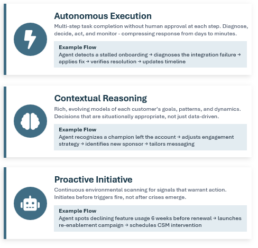
Exhibit 6. Value Realization Methods
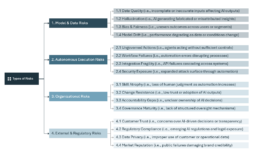
Value Governance - Risks
Exhibit 7. AI and Agentic AI Risks
The Value Realization Office
Every SaaS company has a sales team to win deals, a product team to build features, and a support team to fix problems. Almost none have a team whose sole job is to prove those deals, features, and fixes made the customer’s business better.
What is a VRO?
The VRO is a cross-functional operating system that connects what was promised to what was delivered, continuously, at scale, with AI doing the heavy lifting.
Managing AI-driven value realization at scale requires more than governance policies. It requires an institutional function responsible for orchestrating value delivery, intelligence, and oversight across the lifecycle. As AI systems increasingly influence adoption decisions, optimization workflows, and expansion strategies, organizations must ensure that these capabilities operate within clear accountability structures and consistent measurement frameworks. The VRO serves as the coordinating function responsible for operationalizing this governance model.
The VRO operates as a cross-functional orchestration layer that connects product, customer success, sales, and analytics teams around a shared understanding of customer value.
Its primary objective is to ensure that value promised during the sales process is systematically measured, validated, and expanded throughout the lifecycle. By establishing common value metrics, standardized processes, and consistent reporting structures, the VRO creates the institutional backbone required to manage value realization at scale.
The VRO operates through five interconnected components (Exhibit 8).
Exhibit 8. VRO Operating Model: Lifecycle with Enabling Capabilities
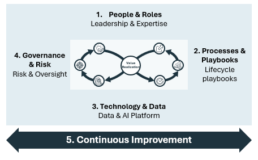
- People and Roles
Led by a VP of Value Realization who reports directly to the CRO or CEO – not buried inside CS. This isn’t a mid-level manager running QBRs. It’s an executive who owns the question “Are our customers achieving what we promised?” across the entire business. Supporting the VP are Value Architects (who design outcome frameworks and success blueprints per segment), Value Engineers (who translate frameworks into customer-specific evidence of impact), an AI/Data Operations lead (who manages the intelligence infrastructure), and a Governance/Enablement lead (who ensures AI systems operate responsibly and that teams adopt new ways of working).
- Processes and Playbooks
The VRO operationalizes the value lifecycle through standardized processes and stage-gate playbooks that define activities, ownership, and success criteria across each lifecycle phase. These playbooks ensure that discovery insights, onboarding plans, adoption strategies, and value evidence are consistently captured and transferred across teams. In AI-enabled environments, the VRO also defines AI engagement rules that determine when automated systems can act autonomously, when human review is required, and when escalation is necessary.
- Technology and Data Architecture
The VRO relies on a layered technology architecture that converts customer signals into actionable insights. A unified data layer integrates CRM, product telemetry, support systems, and financial data into a single source
of truth. Above this sits an AI intelligence layer that applies predictive analytics, anomaly detection, and recommendation engines to identify value opportunities and risks. An orchestration layer converts these insights into coordinated actions, while an agentic layer enables autonomous monitoring and proactive intervention across the lifecycle.
- Governance and Risk Management
The VRO serves as the organizational owner of governance for AI-enabled value realization. It oversees model accuracy, agent behavior, organizational accountability, and customer transparency through a structured risk framework. Regular governance cadences monitor system performance, adoption patterns, and compliance requirements, while escalation protocols and ethics reviews ensure responsible deployment of AI capabilities. This governance structure enables organizations to expand automation while maintaining transparency, control, and trust.
- Continuous Improvement
The VRO embeds continuous learning across the value realization system. Outcome data, lifecycle performance metrics, and AI-generated insights are captured and analyzed to refine playbooks, improve onboarding and adoption strategies, and strengthen value narratives. Outcome libraries, performance reviews, and cross-functional feedback loops allow the organization to systematically incorporate learnings into the lifecycle. Over time, this creates a self-improving system that continuously strengthens value delivery and expansion opportunities.
The Future of Value Realization
Value realization is a defining capability for SaaS providers. As products become increasingly feature-rich and markets more competitive, differentiation will shift from functionality alone to measurable business outcomes. Organizations that treat value realization as an operational discipline rather than a customer success activity will be better positioned to sustain growth and deepen customer relationships.
AI will play a central role in this evolution. Predictive analytics, generative AI, and agentic systems enable continuous monitoring of customer signals, allowing organizations to identify risks, surface opportunities, and initiate interventions earlier than traditional engagement models allow. Instead of relying on periodic reviews and manual analysis, value delivery will increasingly be supported by intelligent systems that analyze data across the lifecycle and guide teams toward actions that maximize impact.
Ultimately, the future of SaaS will be determined by how effectively organizations close the loop between value promised and value delivered. Companies that build the systems, governance, and operating models required to manage this loop at scale will move beyond feature-led selling toward outcome-driven partnerships with their customers.