

Gen AI is Shaking Up the SaaS Market
The rapid rise of Generative AI (Gen AI) is fundamentally reshaping the B2B SaaS landscape, presenting challenges for traditional software providers that have long dominated the market. This is because legacy SaaS platforms, when compared to Gen AI solutions, have high licensing costs, require significant IT resources for customization, and rely on rigid architectures and siloed data, making them less adaptable to evolving business needs.
To address these challenges, enterprises are leveraging Gen AI to lower costs, reduce IT complexity, and improve system flexibility. AI-powered development tools are being used to streamline software creation, reducing the need for extensive IT resources and enabling companies to build tailored solutions faster and with fewer resources. At the same time, AI agents are being leveraged to automate critical SaaS functions such as customer service and sales, reducing reliance on multiple costly subscriptions while consolidating software needs into Gen AI-powered tools. Additionally, Gen AI orchestration agents that can execute tasks across multiple systems through natural language prompting are starting to be deployed, making software interactions more adaptable and reducing dependency on individual solutions.
As a result, Gen AI is expected to be a key driver of growth in the software industry, accounting for 72% of new spending over the next 3 years. In fact, enterprise investment is projected to grow from $15 billion today to $175-250 billion by 2027 (94% CAGR), with 20-35% going towards in-house development (2).
NO INCUMBENT IS SAFE
Gen AI’s impact on incumbents and broader industry dynamics is profound. It is expected to:
1. Accelerate vendor switching in the SaaS market: Gen AI is driving a shift toward more intelligent, AI-native solutions that offer greater automation, adaptability, and decision-making capabilities. At the same time, lower switching costs—due to reduced expenses in data migration, integration development, and user training—are making it easier for businesses to transition away from incumbent providers.
2. Reallocate software spending from buy to build: The latest Gen AI tools are making it easier and more efficient for enterprises to create and customize their own solutions. By automating key development processes, these tools reduce reliance on external software purchases and encourage investment in customized internal builds.
Exhibit 1. Projected Increase in Spending on SaaS Solutions, US$ B (3)

Legacy Software is Struggling to Keep Up
SaaS solutions have long been used to automate and optimize simple processes such as data entry, workflow management, and data analysis. However, the rapid rise of Gen AI solutions has highlighted the limitations and shortcomings of these systems. This is because current widely used software solutions, when compared to Gen AI solutions: (1) have high licensing costs, (2) require large IT teams for customization & maintenance, (3) have a brittle & deterministic architecture, and (4) are siloed solutions that have an incomplete view of a firm’s context & data (See Exhibit 2).
Additionally, the latest generation of AI solutions can seamlessly integrate both structured and unstructured data (such as voice and video) to automate complex processes that are too dynamic to be governed by rigid, rule-based systems. This flexibility enables greater customization through natural language, significantly reducing the need for extensive IT investments and reliance on numerous SaaS providers. In fact, newer agents and AI solutions are allowing employees in different business units to become “citizen developers” who can create their own custom apps, automations, and visualizations by simply prompting a natural language interface.
Exhibit 2. Reasons Firms are Looking to Move from SaaS to Gen AI

Gen AI’s Impact Will Vary Across Software Categories
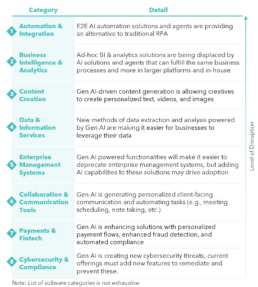
Although we expect every software category to undergo some level of disruption from Gen AI technology, some are more vulnerable than others (Exhibit 3). For example, ad-hoc software focused on high volume, low complexity tasks, such as business intelligence, integration, automation, and data analysis tools are at risk of being completely replaced by AI-driven solutions and agents that can make customizable solutions faster and cheaper.
In addition, large enterprise management platforms (e.g., ERP, CRM, HRMS, etc.), due to their complex nature and compliance/ system security concerns, are not likely to be fully replaced by Gen AI tools. However, as Gen AI-powered tools and agents become more robust and can handle increased complexity, they will be able to move a large portion of the business logic built on top of these platforms to Gen AI tools and potentially remove the dependency entirely.
The software categories that will be better placed to survive the Gen AI disruption will be tools that deliver a service that is simply facilitated using software. For example, payment processors take on financial risk for the client in return for a margin of transaction fees, video-conferencing solutions facilitate cross-firm communications, and cybersecurity systems help firms mitigate enterprise risks and handle complex threats. While many of these solutions will have to leverage Gen AI technology to remain competitive, it is unlikely firms will move their functionalities in-house with or without Gen AI.
Exhibit 3. Impact of Gen AI Disruption by Software Category (9)
Gen AI is Speeding Up Development and Changing how Software is Used
The rise of Generative AI (Gen AI) is fundamentally reshaping the way enterprises interact with software. Companies are increasingly looking to AI-driven automation and intelligence to save money and enhance efficiency. There are three main ways we are seeing Gen AI reshaping enterprise software now and in the future:
1. Enabling Faster Development of In-House, Tailored Solutions: Gen AI is accelerating software development, reducing the time and expertise required to create new applications. AI-powered development tools automate coding, testing, and deployment, making it easier for companies to build tailored in-house solutions.
2. Replacing SaaS Tools with AI-Driven Automation: Gen AI is automating key activities typically undertaken by SaaS tools such as customer service, sales, and project management. As AI handles these tasks, businesses are reducing their reliance on multiple SaaS subscriptions, consolidating software needs under AI-driven solutions.
3. Changing the Way Users Interact with SaaS Tools: Firms are starting to look to Gen AI as an intelligent orchestration layer that connects systems and automates workflows. AI-driven agents are increasingly replacing rigid SaaS interfaces, enabling more dynamic user interaction. As AI takes over this core function, traditional SaaS models may evolve into “headless” systems where AI manages tool usage and integrations, fostering flexibility and reducing vendor lock-in.
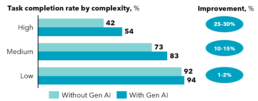
Exhibit 4. Impact of Gen AI Disruption by Software Category

1. ENABLING FASTER DEVELOPMENT OF IN-HOUSE SOLUTIONS
The rise of AI-powered coding tools is lowering barriers to software development, enabling businesses to shift from SaaS dependency to customized in-house solutions. Traditionally, software development required dedicated teams, creating bottlenecks for companies with limited resources. AI now enables those with limited knowledge in a field to develop and deploy applications efficiently. In fact, a recent study found that for tasks developers deemed to be of high complexity, participants were 25-30% more likely to complete the task using Gen AI (Exhibit 4).
On top of that, AI coding assistants significantly boost development speed and efficiency, improving developer productivity by 55% on average (14) , reducing costs, and freeing engineers to focus on innovation rather than performing menial, repetitive tasks and relying on external SaaS vendors. For example, Uber’s QueryGPT automates SQL generation, saving 140,000 hours annually and reducing query time by 70% (from 10 minutes to 3) (15).
Additionally, AI is evolving beyond co-pilots into autonomous AI engineering agents. For example, in 2024, Cognition Labs released Devin AI, which autonomously handles development tasks. The agent scored a 13.86% on SWE-Bench (which tasks the AI with solving real-world GitHub issues), outperforming previous state-of-the-art AI models (such as GPT-4) by over 7x (17).
Since then, autonomous AI coding agents have been deployed across many large enterprises with impressive results, for example:
- Google deployed Goose, an AI agent trained using Gemini and their internal code base, in 2024 which has helped the firm automate the generation of ~25% of their new code (18)
- Using Amazon Q internally, Amazon automated the migration of 30,000+ Java applications, saving $260 million and modernizing the firm’s infrastructure (16)
- Block deployed its open-source AI agent, codename goose, to 1,000 of its engineers, who report it’s made them ~25% more productive by automating repetitive tasks (e.g., refactoring applications) (20)
As AI-driven development continues to advance, companies will increasingly shift from relying on external SaaS providers to building tailored in-house solutions.
Exhibit 5. Gen AI Code Development Case Study (19)
2. REPLACING SAAS TOOLS WITH AI-DRIVEN AUTOMATION
Cutting-edge firms are reducing their dependency on SaaS by leveraging AI-driven solutions. These firms are migrating internal data away from siloed SaaS platforms to effectively train AI agents and tools that deliver unique value beyond typical SaaS capabilities. Although this approach does not eliminate all SaaS, it creates a leaner tech stack that supports effective Gen AI deployment.
For example, in August 2024, Klarna announced it was deprecating Workday and Salesforce to bring its data in-house. While it still uses some SaaS solutions such as Deel and Slack, Klarna has significantly reduced its SaaS dependency and deployed several Gen AI–driven solutions that have added substantial value.14 One such solution is their AI Assistant that is now available to customers (Exhibit 5). By leveraging the assistant, Klarna removed the need for clunky chatbots and automated the resolution of ~67% of its customer service tickets, eliminating the need for approximately 700 full-time representatives (22).
Overall, agentic AI solutions are enabling more powerful automation that requires less maintenance and human oversight than previous SaaS-driven systems. This advancement has broadened the scope of enterprise automation to encompass entire end-to-end workflows. Consequently, by leveraging Gen AI technology, many companies have eliminated the need for hundreds of employees and several SaaS applications, and this is only the start. It’s estimated that more than 40% of all US work can be augmented or automated using gen AI (21).
Exhibit 6. Klarna AI Assistant Case Study (22)

3. CHANGING THE WAY USERS INTERACT WITH SAAS TOOLS
In addition to expanding the scope of enterprise automation, Agentic AI infrastructure is starting to change the way enterprise users interact with SaaS and other software tools. With AI-driven architectures, business logic is moving away from static applications and into autonomous AI agents that dynamically adapt, integrate seamlessly across platforms, and execute tasks independently.
Rather than interacting with multiple SaaS tools, business users are starting to rely on AI agents to fully manage processes across disparate systems. These agents operate as decision layers, intelligently retrieving, processing, and acting on data without human intervention. This shift is not only reducing dependency on SaaS platforms but is also enabling leaner, more adaptable tech stacks. In fact, as AI agents continue to take over core decision-making and process execution, traditional SaaS models may evolve into “headless” systems, where the user interface is replaced by AI-driven automation. In the future, software may simply function as an intelligent backend while AI autonomously manages workflows, integrations, and optimizations.
This shift will help enterprises move away from rigid, monolithic SaaS applications, allowing for greater flexibility, efficiency, and adaptability in software ecosystems. Additionally, by removing deep dependencies on individual SaaS platforms, vendor switching becomes significantly easier, allowing businesses to seamlessly migrate to new tools without the friction traditionally associated with SaaS transitions.
Exhibit 7. Future State AI Operating System (23)

In Closing...
Over the past few years, Gen AI has moved from a buzzword to a tangible technology providing firms with trackable improvements in productivity and margins. In fact, technology powered by Gen AI has exposed weak points in current enterprise software solutions, including high licensing costs, expensive customization, brittle automation, and siloed data. Because of this, Gen AI is already starting to disrupt the SaaS marketplace by making it easier to build solutions in-house and providing automation tools that reduce the need for and dependency on other solutions. In addition, novel AI agents are beginning to take over end-to-end workflows that used to be undertaken by humans, allowing companies to reduce headcount in functions that have large amounts of manual and repetitive tasks.
While the exact future state of Generative AI and Software as a Service is still evolving, one thing is clear: Gen AI is set to transform how users and organizations interact with data and software. Although traditional AI models and SaaS solutions will continue to excel in certain types of analysis and automation, Gen AI-powered agents, acting as decision engines, will increasingly take over tasks that were previously handled by software solutions and humans.
As a result, firms that quickly adopt and test these tools will gain a competitive edge, while those that delay risk falling behind in a rapidly changing landscape.
- SaaS Capital
- McKinsey
- Two Reports (Precedence Research, 2024; McKinsey, 2023)
- Menlo Ventures
- Morgan Franklin
- Productiv
- Ultra Consultants
- Josys
- McKinsey
- Forbes
- Business Insider
- Sequoia Capital
- CXToday
- Github
- Uber
- Amazon Q
- Cognition Labs
- McKinsey (participants given a set time to complete various coding tasks they then ranked by complexity)
- Business Insider
- Harvard Business Review
- Two Sources (Sequoia Capital Podcast; Klarna)
- Building an AI Operating System, apidays Singapore 2024