


The Change that is Inevitable
Hidden costs have always plagued Procurement. As vendor ecosystems and spend expanded, these costs became increasingly dispersed, embedded in overlapping suppliers, outdated scope-of-services, under-managed renewals, and insufficient performance oversight.
What was once a transactional, document and human-driven function is now expected to manage a level of scale and complexity it was never designed for. Procurement teams are expected to control costs, mitigate risk, and ensure compliance, but they are operating in an environment where information is fragmented, vendor portfolios are expansive, and contractual obligations are too complex to track manually.
This is why AI/ML is no longer an enhancement to procurement; it is a structural shift. It changes procurement from a reactive, document-processing function into a proactive intelligence layer that continuously makes sense of vendor data, contract terms, market benchmarks, and organizational policies.
Instead of manually reviewing documents, AI/ML can interpret them at scale and with consistency; instead of relying on fragmented spreadsheets, AI can connect pricing, risk, performance, and compliance data into a unified picture. Modern AI/ML systems can analyze vendor credentials, detect deviations from standard terms, flag cost anomalies, model true cost of ownership, assess third-party risk, track renewal timelines, and even draft RFPs or policy-aligned documentation automatically.
In other words: procurement used to chase information; AI/ML now brings the information to procurement. This shift enables teams to make decisions with full visibility; identifying redundant vendors, negotiating with better leverage, enforcing consistent policy application, and preventing leakage before it occurs.
Where Traditional Approaches are Failing
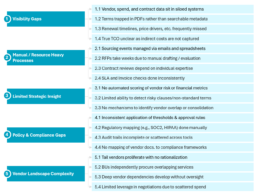
Traditional procurement struggles today not because teams lack capability, but because the operating model itself was built for a very different environment. Most organizations continue to operate with fragmented procurement processes, lacking a unified approach across requirements intake, sourcing, contracting, and vendor performance management.
In this setup, information rarely flows end-to-end. Requirements are defined without full visibility into existing contracts; sourcing decisions are made without clear understanding of historical performance; legal reviews happen without context on pricing benchmarks; and vendor management teams often inherit contracts they had no involvement in negotiating.
This fragmentation creates blind spots at every stage. Pricing logic, rate escalators, renewal triggers, volume tiers, and exceptions remain buried deep in contractual text; vendor risk assessments are completed once and rarely revisited; and spend becomes increasingly distributed across business units with no mechanism to detect overlap or duplication. Over time, organizations accumulate vendors, duplicate tools, inconsistent commercial terms, and long-term dependencies that lock them into suboptimal arrangements. The problem is not just inefficiency, it’s the absence of a unified, intelligence-driven picture of the procurement lifecycle.
Exhibit 1. Issues with Traditional Approaches
The Augmented Procurement Lifecycle
The opportunities for AI/ML are no longer limited to contract review or spend analytics. It can now support every stage of the procurement lifecycle to turn into a connected, intelligence-led flow.
Exhibit 2. AI-Augmented Procurement Lifecycle

AI in Discovery
AI transforms the Discovery stage by giving procurement immediate clarity on whether a request is new, redundant, or already covered. Before processing each intake item, AI interprets natural-language requests, compares them to existing contracts, identifies overlaps across departments, and surfaces consolidation opportunities before sourcing begins. It also brings adaptive forecasting, using ML to analyze usage patterns, operational signals, supplier performance, and market volatility. This prevents unnecessary RFPs, steers demand to approved vendors, and shapes the sourcing pipeline around aggregated, validated, and strategically aligned requirements.
AI-driven forecasting models can improve accuracy by 20–50% (1), minimizing emergency purchases and enabling negotiations based on high-confidence volume expectations. At the intake level, AI helps identify when multiple teams are requesting similar tools or services, allowing procurement to redirect them to existing contracts or preferred suppliers. Deutsche Telekom (2) has successfully implemented cognitive procurement to better manage its strategic sourcing initiatives. Leveraging AI/ML, they have optimized spend analysis and supplier management, reducing costs and minimizing the risk of supply chain disruptions. Together, these outcomes streamline the front end of procurement. In the Discovery stage, AI acts as a gatekeeper, preventing unnecessary spend before it ever crystallizes into a sourcing event.
AI in Sourcing
AI elevates the sourcing stage by automating core analytical tasks such as RFP creation, response normalization, and benchmarking against historical events and current market data. Modern AI tools can generate tailored RFPs from high-level requirements, extract evaluation criteria, and instantly benchmark them against historical events. They can compare vendor proposals at scale, summarizing key differences, highlighting deviations from requirements, and isolating commercial and contractual risks that would normally take hours of manual review.
AI also enriches supplier evaluation by incorporating real‑time data on financial health, operational performance, ESG posture, risk scores, pricing trends, and market intelligence, providing a more objective basis for supplier selection. This reduces the administrative burden on category teams, shortens sourcing cycles, and ensures that final supplier selections are grounded in consistent, data-driven analysis rather than subjective interpretation or incomplete information.
Real‑world deployments illustrate these gains. Walmart’s AI‑powered negotiation chatbot for selected suppliers has reached agreements with roughly 64% of suppliers engaged, delivered about 1.5% (3) savings on the spend it negotiates, and extended payment terms by around 35 days on average, demonstrating more fact‑based, scalable negotiation outcomes.
AI in Contracting
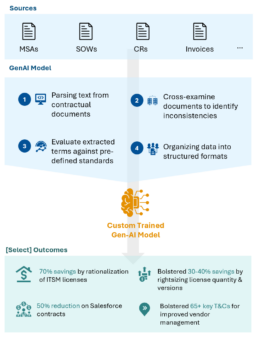
AI transforms the contracting phase by turning dense agreements into structured, searchable intelligence. AI can extract key terms, compare them against playbooks, identify deviations, and flag clauses with commercial, operational, or compliance risk, resulting in 70–85% (4) reduction in review time per contract. They can also benchmark pricing structures, renewal mechanics, rate cards, and service obligations against historical contracts and norms, strengthening the negotiation position and lowering administrative costs. AI further streamlines contract drafting by generating first drafts from templates, inserting scenario‑appropriate legal language, and enforcing consistency across agreements. Legal and procurement functions are also using AI to analyze negotiation history, supplier performance, and prior disputes to propose fallback clauses and protections automatically, aligning new contracts more tightly with risk appetite and commercial strategy.
The average medium to large enterprise manages contracts across 24 (5) different systems. AI also enables a centralized digital contract repository, turning scattered PDFs into a structured, searchable source of truth. By automatically tagging contracts with renewal dates, obligations, rate structures, risks, and exceptions, AI gives teams instant visibility into terms across the portfolio: reducing missed renewals, inconsistencies, and audit gaps. The value is proven: a Fortune 100 company applied extractive AI to 12,000 contracts and uncovered $4.6M (6) in unbilled revenue and expired discounts, showing how an AI-driven repository can directly recover financial value. Over time, this repository becomes a strategic asset for benchmarking, negotiation, and stronger commercial governance.
Exhibit 3. Kepler’s AI-enabled Vendor Contract Evaluation, Re-negotiation & Optimization Tool
AI in Management
An average of 9.2% (7) annual revenue is lost due to contract mismanagement. Obligations sit in PDFs, renewals are tracked manually, SLAs are inconsistently monitored, and pricing changes often go unnoticed. This fragmentation is costly: organizations lose up to 40% (7) of a contract’s value during the post-signature phase due to missed obligations, and non-compliant supplier behavior. The problem is compounded by poor visibility: 71% (7) of companies cannot locate at least 10% (7) of their contracts, exposing them to penalties, missed renewals, and avoidable revenue loss.
AI closes these gaps by providing continuous, automated visibility into obligations, SLAs, pricing terms, renewals, and performance metrics. Instead of relying on periodic manual checks, AI links contract metadata to real-time operational and financial data, flagging SLA breaches, missed service credits, duplicate billing, off-contract spend, and expiring discounts as they occur. This automation enables teams to intervene before value leakage occurs. As a result, companies using AI-driven contract management can accelerate negotiation cycles by 50% (7), while also reducing inaccurate payments by 75-90% (7). AI effectively turns contract management into an always-on governance engine: protecting commercial value, strengthening supplier accountability, and ensuring organizations capture the full benefit of what they negotiate.
How to Get Started?
A structured, phased approach ensures early wins, faster adoption, and minimal disruption to business operations.
1. Start with a High-Value, Narrow Scope: Identify and prioritize 3–5 targeted use cases with clear ROI (e.g., intake classification, vendor shortlisting, contract clause extraction). Starting small helps build confidence, demonstrate impact, and avoid overwhelming the operating model. Early success accelerates enterprise-wide adoption.
2. Build the Data Foundation: AI in procurement depends on clean, connected data across spend, contracts, suppliers, performance metrics, and workflows. Organizations should establish a unified vendor and contract repository, standardize taxonomies, and integrate systems (ERP, P2P, CLM). Even partial structuring (e.g., contracts tagged with key metadata) dramatically improves AI performance.
3. Embed AI into Existing Processes: AI delivers the most value when it supports daily workflows (e.g., evaluating RFP responses, flagging risky clauses, etc.). Start by placing AI “copilots” within current sourcing, contracting, and vendor-management processes so teams naturally adopt AI rather than resist it.
4. Establish Governance: Successful AI programs define ownership, set guardrails, and track outcomes. Create a cross-functional governance group (procurement, legal, IT, data) to oversee models, data quality, and compliance. Measure ROI through cycle-time reduction, savings captured, risk mitigated and avoided value leakage. Clear metrics ensure AI investments scale responsibly.
In Closing
AI is reshaping procurement end-to-end: from how demand is captured to how suppliers are selected, contracts are governed, and value is secured throughout the lifecycle. When done well, AI doesn’t just automate tasks, it elevates procurement into a proactive, intelligence-driven function that protects value, reduces risk, and strengthens commercial performance.
For most enterprises, the challenge is not recognizing the potential of AI, operationalizing it. We bring proven frameworks, deep procurement expertise, and hands-on experience building AI-enabled workflows across the procurement lifecycle. Whether it is identifying high-ROI use cases, structuring contract and vendor data, designing AI-supported processes, or piloting a targeted sprint to demonstrate value, we help organizations move from ambition to measurable impact, quickly and confidently. As procurement enters a new era of intelligence, our role is to ensure you capture its full value from day one.
- Blue Ridge
- C-Suite Strategy 2025
- ProcureCon 2025
- LegalOn 2025
- Malbek 2025
- HyperStart 2025
- Procurement Tactics 2025