

Why Is AI Highly Applicable To CX?
Customer support is at the forefront of AI adoption due to its ability to solve acute challenges in the process. Over 85% of organizations are investing in AI to improve business functions and customer service is the second highest priority for businesses for AI investment (behind IT) (1). This high adoption is driven by the substantial return on investment (ROI) and benefits, as approximately 60% of client support leaders are already seeing positive outcomes from their automation efforts, including chatbots and automatic routing (2). Despite years of effort and a plethora of efficiency-enhancing technologies, customer care leaders still report that contact centers are burdened by increasing call volumes and consistent employee attrition of 30-45% (3). Meanwhile, some of the largest consumer-facing technology organizations have become exceptional at digitally enabled customer care, lifting customer expectations everywhere with 65% of clients expecting instant responses adding pressure to streamline and personalize CX (4).
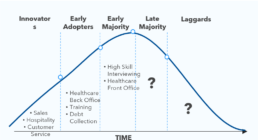
Exhibit 1. Drivers of AI Growth In Customer Service
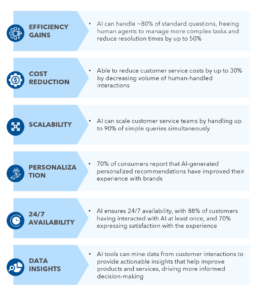
AI Capabilities & Use Cases Across CX
AI capabilities offer a strong, cutting-edge platform for the development of use cases that may assist customer service and support enterprises in providing better, more effective customer care. Leaders in customer service and support should utilize this information to assist them determine which AI capabilities are practical to implement right away. Additionally, the material gives service leaders information to help them become acquainted with other AI capabilities, which come with extra dependencies and make adoption more difficult. Starting with a list of use cases for text analytics, content production, and content utility enables executives to immediately see the advantages of AI technology and consider scaling up the experience across other use cases.
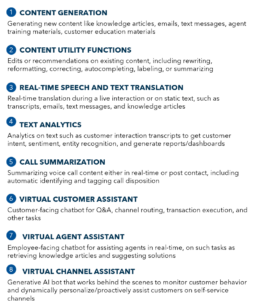
The most impactful use case and low-hanging fruit is content generation and text analysis. For example, content generation tasks related knowledge articles, FAQs, emails, text messages, agent training materials, customer education materials (e.g., product information), customer communication related to case management, can easily be performed by AI. Similarly, text analytics task like identifying intent in customer interaction transcripts Identify sentiment in customer interaction transcripts, recognizing entities (product/issue type) in customer interaction transcripts etc. also provide tangible benefits quickly
Exhibit 2. AI Capabilities in Customer Service
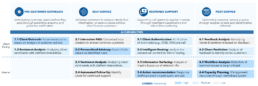
The tasks where AI can plug in can be categorized across the client lifecycle:
Pre-Onboarding: Personalized, interactive onboarding, guiding customers through product discovery and account setup with moderate level of maturity. Over 80% of top executives use AI to differentiate services and attract customers through highly personalized experiences (4)
Self-Service Issue Resolution: Expedite onboarding issue resolution by promptly handling inquiries through self-help resources or intelligently directing complex issues to live agents. Almost 86% customers prefer multiple communication and expect to maintain context shifting between these channels (3)
Response Support: Provide personalized financial advice, detect fraud, enhance security & identifying opportunity for cross-sell and upsell and resolve common issues (e.g.,Bank of America’s Erica responded to 800M inquiries from ~42 M clients, providing insights and guidance over 1.2 B times) (2)
Post Service: AI ensures ongoing customer engagement by monitoring satisfaction, offering proactive solutions, and recommending personalized products. It automates follow-ups and gathers feedback to improve retention and long-term loyalty.
Exhibit 3. AI Use Cases Across Client Lifecycle
Future-proof Implementation Strategy
To appropriately address the challenges and avoid pitfalls during AI integration, FIs need to develop a customized strategy:
Exhibit 4. AI Chatbot integration
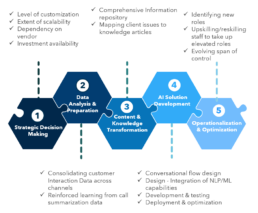
1. Strategic Decision Making
- Strategic Alignment: Aligning AI solution deployment with the overarching customer support strategy before implementation allows financial institutions to attain optimal service efficiency, enhance customer experiences, strategically select and utilize key performance metrics, and leverage customer insights for continuous improvement. This method optimizes support to foster long-term customer loyalty
- Compliance & Regulations: AI must comply with data privacy, AML/KYC, fair lending, consumer protection, and operational risk regulations. Regular audits, training, collaboration with compliance teams, and algorithm transparency are essential to maintain adherence to these regulatory requirements
- Deployment Strategy (Build Vs Buy): B2C entities, with high-volume, simple interactions, may prefer external solutions, while B2B organizations, dealing with sensitive, complex data, may favor in-house development. When integrating AI into customer support, 32% of organizations prefer building in-house, while 28% opt for off-the-shelf solutions (5)
2. Data Analysis & Preparation
Successful AI implementation hinges on comprehensive data and insights to optimize functionality and user satisfaction. Key focus areas include:
- Comprehensive Customer Interaction Data Analysis: Involves creating a unified repository by integrating data from sources like support tickets, emails, and call interactions, then conducting data mining to detect patterns, perform sentiment analysis using NLP, and apply predictive analytics with machine learning models to enhance understanding of customer behavior
- Development of Intelligent Routing: Creating a dynamic classification system that accurately maps customer inquiries to appropriate categories and subcategories, based on their complexity levels to be later used for navigation under self help service or assisting support agent internally
- Establishing KPIs for performance tracking: Prioritizing KPIs that measure the integration program’s effectiveness, which can also be leveraged for optimizing AI capabilities post integration within the customer support
3. Content & Knowledge Transformation
Consolidated data needs to be laid out in the chatbot’s comprehensible format as well as for easily to be understood by agents:
- Content & Knowledge Transformation: Internal knowledge repositories need to be consolidated in a standardized format that is consumable by AI. This process enhances content comprehensibility for merchants/customers and ensures accessibility via keyword searches during solution-seeking interactions. Notably, 51% of companies struggle to use AI due to the lack of structured customer history for customization6
- Knowledge Management Tool Consolidation: A crucial part in facilitating the entire integration of AI are the software applications and APIs that facilitate the collection, organization, and distribution of information across the entire customer support for assistance. For example, if your team uses a CRM, you can store data about past interactions with your customers. Then, you can recall that information the next time the customer reaches out to your business.
4. AI Solution Development
There are many solutions for the development of an AI solution (e.g., chatbot) in the market depending on the level of investment and risk appetite. The options to use a ready-made off-the-shelf solution is the quickest route to getting a product operational and integrated in CX processes.
- Vendor Products: GenAI-driven features like Microsoft 365 Copilot and Google Workspace can be purchased for service organizations. Vendors handle risk management, data protection, and secure interaction with GenAI models.
- General-Purpose Models: Publicly accessible LLMs (e.g., ChatGPT, Bard) can be used via APIs or integrated into custom applications. Service leaders should ensure prompt engineering and human-in-the-loop reviews before deploying them.
- Custom Models: Custom LLMs are tailored for specific organizations, offering data privacy and fine-tuning with internal knowledge. Companies can subscribe to private instances or build their own models to fit business needs. Model assessment is key to finding the right fit.
However, many companies are choosing to develop or customize their solutions in house due to better ability to control AI features and increase security and compliance with financial services regulations. For a rapid development of AI solutions in house, multiple development teams can work concurrently supported by a robust governance program managing the milestones. The key activities and milestones for in-house development of an AI solution include
- Technology Assessment & Development: In-depth assessment of business needs, user demographics, scope, features, and platforms
- Content Curation & Validation: Involves crafting user interface, integration with existing CRM, architecting system, coding logic, integrating APIs, and training AI models leveraging the existing data and knowledge management functions
- Deployment & Testing: Following comprehensive validation to ensure functionality and responsiveness, the AI solution is deployed. Subsequently, its performance is persistently monitored using functionality testing, performance testing and user acceptance testing for optimization and issue resolution
5. Organization Restructuring Post Integration
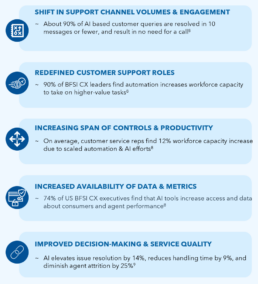
Customer service provides an instructive case in point of the ways generative AI will enrich — not erase — jobs. AI lowers the cost of operations and headcount of live agents leading to organizational transformation initiatives. Amidst rising call complexities, CX leaders are leveraging automation, driving a 90% increase in workforce capacity7. Post AI implementation, tasks are split into:
- Human tasks: unaffected by AI implementation that require the arrangement of customer-facing environments and directing organizational operations, activities, and procedures
- Automated Tasks: Fully and effectively automated repetitive structured tasks such as determining the prices of goods and services and collecting payments.
- Augmented & Enriched Tasks: Reinvented collaborative tasks between customer service reps (CSRs) and AI for activities like solving complex inquiries, preventing attrition etc.
A creative mix of human, automated, and augmented tasks can give organizations a leg up on less imaginative competitors. To tap the full AI potential, CX should perform new & unprecedented tasks that have a premium on distinctively human tasks.
Exhibit 5. Key Impacts Of AI Implementation
Benefits Of AI In Customer Service
Deployment of AI has a multitude of benefits for the client experience and increased internal efficiency. Given the flexible sourcing and relatively low cost to using custom models, the ROI from the implementation of these capabilities has the potential to be very high. The ROI can also free up the agents to take on more complex customer intents, helping to improve service quality and retention.
Examples of successful AI solutions have become very prevalent among financial services.
- Bank of America’s Erica, one of the earliest chatbots launched, has handled over 1.5B client interactions since 2020 and has an 80% call containment rate (11)
- Standard Chartered bank saw a 2X increase in engagement level $5 saved on average for every deflected call through its implementation of the Kasisto chatbot (12)
- Commonwealth Bank saw 550,000 queries every month with 87% first contact resolution and a 60% call containment rate through its implementation of Ceba by Nuance (13)
- Ally Financial’s in house solution provided them with time saving 34%, 3 minutes reduced per call, 87% bank customer satisfaction, +90% retention rate (12)
Exhibit 6. Benefits & Features (Case Study Klarna)
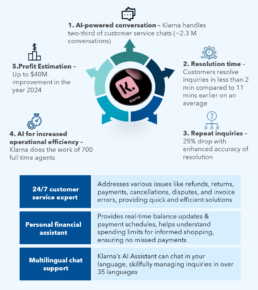
However, a close monitoring of the cost and benefits of AI adoption allows companies to track the success or failures of AI across identified objectives and KPI goals. The succinct measurement of outcomes against a thorough business case creates an implementation roadmap that enables executives to make decisions on redeploying AI to high impact areas and divesting from areas with low ROI or harmful client experience outcomes. The key metrics that measure effectiveness of AI are:
- Call Reduction: Reduced number of incoming calls to live agents since issues are resolved via interactions with AI and self-service
- Average Handle Time: Increase in agent efficiency on call utilizing AI features (e.g., call summarization, information surfacing)
- Customer Satisfaction: Increase of client satisfaction due to the ability to self-serve and reduce wait times to resolve issues
Exhibit 7. Kepler’s AI Cost Benefit Analysis Framework

When is AI Not The Answer?
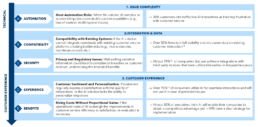
The integration of AI across the client lifecycle is not a strategy that can remediate all existing issues client have and should not be seen as a “silver bullet” solution. The integration of AI should follow careful considerations and strategic planning to avoid common pitfalls and challenges:
Exhibit 8. Typical Challenges
In Conclusion
Financial institutions must harness the ongoing enhancement in AI capability, embracing the momentum of deployment of AI technologies across variety of use cases within the industry. By integrating AI, financial institutions can engage both organizations and customers in a cycle of continuous learning and improvement. This interaction fosters mutual development and innovation, driving better service delivery and customer satisfaction. While cost efficiency is a significant advantage, the benefits of AI extend much further into improved customer engagement and service quality, contributing to stronger, more enduring customer relationships.
The integration of AI is not without challenges as financial institutions must navigate issues such as data privacy and security maintaining transparency with customers about how their data is used, managing the complexity of integrating AI systems with existing legacy infrastructures, can pose significant technical hurdles. Addressing these challenges head-on is essential for the successful deployment and long-term viability of AI in the financial sector.
- Gartner
- TechRepublic
- Zen Desk
- Nextiva
- IBM
- IBM
- FinancesOnline
- Klarna
- WWD
- Tearsheet
- IBM
- Nuance
- Ally
- Klarna
- Techreport
- FinancesOnline