

The Need for Business Agility
The US healthcare industry is going through a metamorphosis.
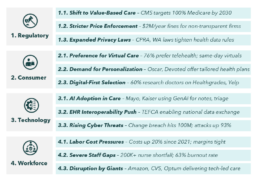
Center for Medicare & Medicaid Services’ (CMS) demands for value-based care, data sharing, and price transparency are driving operational transformation. In addition, regulatory shifts, technology advances, and changes by the current administration require hospital systems to adapt. All of this is on top of patients demanding digital access, personalized care, and seamless experiences.
Medical costs also continue rising – projected to increase 8.0% for Group and 7.5% for Individual plans – requiring greater efficiency.
The increasing financial divide between the haves and the have nots in the industry is increasing. Some organizations are projecting growth for 2025, while others are struggling.2
Those pursuing growth through M&A are finding that transaction volume alone does not guarantee success. The difference lies in execution: the ability to quickly integrate new entities, adapt operations, and shift direction as needed.
Leading healthcare organizations recognize that agility – not just size –is a key competitive advantage today.
What is Business Agility?
True agility goes beyond speed. It means purposefully adapting to launch new services, adjust costs, integrate partners, and transform care delivery with minimal disruption.
In healthcare, where one-size-fits-all approaches fail, the ability to respond appropriately to each situation is critical. Building an agile business model requires laying the right foundation. Yet many face structural barriers.
Exhibit 1. Structural Shifts forcing Agility in Healthcare
Aspiration Meets Reality
Healthcare firms are actively responding to market pressures and opportunities. From revenue cycle redesign to service line expansion, these efforts aim to strengthen competitive positioning.
Organizations are transforming legacy processes and modernize technology. Many are expanding into adjacent markets or services —with urgent care projected to reach $48 billion by 2030 and home healthcare expected to exceed $420 billion by 2025. Others are pursuing strategic partnerships to access new capabilities and markets.
Yet the results remain underwhelming. An analysis revealed, 50% of the acquiring healthcare companies typically experienced a negative excessive return ranging from 0% to -30%. Similarly, major technology implementations frequently exceed budgets and miss deadlines. These failures stem not from strategic direction but from fundamental agility limitations.
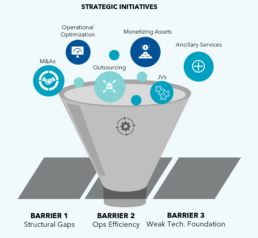
As illustrated in Exhibit 2, healthcare organizations consistently encounter three interconnected barriers that constrain agility: structural gaps, operational inefficiencies, and weak technological foundations.
The following sections examine these obstacles in detail and introduce the essential capabilities that enable true agility in today’s healthcare environment.
Exhibit 2. Systemic Barriers to Strategic Initiatives
Potholes on the Path to Agility
Current practices fall short in several areas:
1. Structural Gaps
Organizations cannot move quickly when internal teams and external partners operate with differing priorities, misaligned incentives, and inconsistent definitions. Common examples include:
1A. Siloed Operations
There is a long-standing divide between Business and IT functions. To bridge the Business–IT divide, organizations often set up central offices – like Digital Transformation or Enterprise PMOs. However, these static layers, while well-intentioned, often become barriers. Instead of driving agility, they add a third party that mediates between two already disconnected groups, making it harder to move fast and deepening the silos they were meant to dissolve.
1B. Insufficient Execution Rigor
Transformations falter when organizations lack a synchronized, enterprise-wide playbook. Teams frequently operate in silos, each executing against different timelines, priorities, and success metrics. Without aligned triggers for decision-making, efforts become disjointed and uncoordinated. The absence of a common transformation roadmap makes it impossible to effectively pivot when market conditions change, as there is no shared understanding of when or how to adapt.
1C. Fragmented Data and Tech Landscape
When teams rely on disconnected systems or conflicting metrics, it creates confusion over what is “true,” slows decision-making, and undermines cross-functional coordination – making it nearly impossible to respond quickly or drive unified action.
2. Operational Inefficiencies
Organizations struggling with limited cost visibility, redundant spend, and unclear value attribution often lack the agility to shift resources when priorities change. Without a clear line of sight into where time, budget, and effort are being consumed, leaders can not make informed trade-offs—slowing down decision-making and locking the organization into outdated ways of working.
2A. Disconnected Data & Systems
Healthcare data remains highly fragmented. Vendor relationships alone can span across four or more systems, while data also flows in from brokers, government agencies, TPAs, and others. Without a centralized source of truth, leaders are often forced to make decisions with limited visibility.
This fragmentation leads to costly inefficiencies, we have seen providers pay for two EHR systems at once. Despite transitioning to a new platform, lingering dependencies on old systems and rigid contracts with high minimum commitments made a phased transition unfeasible.
2B. Ineffective Investment and Risk Management
Investment decisions often happen without clear frameworks or visibility into underlying assumptions. In many cases, assumptions are undocumented or concentrated within a single siloed team, making it hard to challenge or validate them. This leads to misaligned priorities, with capital flowing to low-impact initiatives
3. Weak Technological Foundation
Healthcare organizations continue to operate with outdated tech infrastructure that limits agility. ~70% of hospitals are still running legacy systems that are at least a decade old, with critical infrastructure often dating back to the early 2000s. This widespread reliance on aging technology creates substantial barriers to transformation.
3A. Interoperability
Outdated systems create inefficient workflows, data silos, and security risks. With poor integration, teams rely on manual processes and disconnected databases, making it hard to adapt or scale. Modernization becomes a complex, expensive effort. Recently, diagnosis of an adjudication tool, estimated at $1M per year, uncovered a total-cost-of ownership of $25M+ due to opportunistic tech patchwork, and operational workarounds.
Foundational Pillars
To enable true agility, organizations must first establish a strong, repeatable foundation – one that remains resilient and adaptable, regardless of business conditions. This foundation should not be tied to any single initiative or moment in time but instead designed to support continuous transformation.
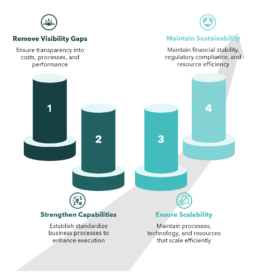
The building blocks that serve as the pillars of agile healthcare operations include:
1. Visibility → Clear line of sight into operations, spend, and performance
2. Capability → Services, talent, tools, and processes to act on insight
3. Scalability → Infrastructure and systems that can flex with growth
4. Sustainability → Governance and alignment to maintain momentum over time
These pillars are not standalone. Each one builds on the other: organizations must first see (Visibility), then act (Capability), expand (Scalability), and finally endure (Sustainability). Together, they create the conditions for meaningful and lasting agility.
Exhibit 3. Pillars of Achieving Agility
1. Remove Visibility Gaps
1A. Metadata Capture
Complete visibility begins with comprehensive metadata capture. Organizations must develop detailed taxonomies that catalog vendors, resources, and services across the enterprise. This framework should classify and tag each resource based on critical attributes — function, frequency of use, cost structures, dependencies etc. Without this, operations remains opaque, preventing leaders from seeing exactly where resources are allocated.
1B. Total Cost of Ownership
True spend visibility requires complete cost footprint across the organization including — clinical services (acute care, outpatient, diagnostics etc.) and corporate operations (HR, IT, legal etc.). This approach reveals the TCO for each capability, uncovering hidden costs and interdependencies that siloed views miss. In the interconnected ecosystem, vendor and FTEs responsibilities typically span across departments — a complete view enables strategic cost optimization.
1C. Performance Benchmarking and ROI
Performance benchmarking and accurate return calculations allow organizations to identify optimization opportunities and establish realistic targets. This comparative view transforms raw spending data into actionable intelligence and organizations can direct capital to high-return initiatives rather than pursuing arbitrary cost reductions that may compromise clinical outcomes or strategic positioning.
2. Strengthen Capabilities
2A. Market-Facing Capabilities
A standardized business capability model that maps all business functions, corporate services, and supporting technologies to market requirements creates a common language for assessing relative strengths and gaps of an organization. Without such a capability architecture, critical functions remain disconnected, creating service vulnerabilities and operational inefficiencies. Lack of such a market facing capability model hinders industry comparison and key decisions.
2B. Integrated Technology
Legacy systems weaken operational capabilities due to fragmentation, driving up costs, and limiting flexibility. Healthcare organizations must strengthen their technology capabilities by implementing integrated platforms like CAPS (Core Administrative Processing Solutions) and EIP (Enterprise Imaging Platform) that consolidate previously siloed functions. This integration strengthens enterprise capabilities by eliminating fragmented systems, reducing interface complexity, and creating technology foundations that can adapt to evolving clinical and administrative requirements.
2C. Corporate Services
Corporate services harmonization across the enterprise ensures business units can identify their dependencies on shared functions—Finance, HR, IT, Legal, Facilities — and incorporate accurate overhead allocations when calculating the total cost of capabilities.
3. Ensure Scalability
3A. Digital Infrastructure
Scalable infrastructure ensures that as patient volumes, services, and business units expand, operational capacity scales proportionally without excessive overhead. Scaling operations require modular, cloud-based technology solutions that can adapt dynamically to changing demands.
3B. Repeatable Execution
To sustain growth without escalating costs, organizations must automate repetitive tasks (e.g., claims processing, billing, scheduling); eliminate redundant processes; align workflows with strategic priorities. Scaling up through complex JVs, partnerships, or new service lines requires quick repeatable execution frameworks. Organizations should develop standardized playbooks outlining key processes and risk mitigation strategies to ensure consistent, high-efficiency execution models.
3C. Consumption-based Accounting
There is need to transition from traditional budgeting models to consumption-based accounting, where expenses are tracked based on actual usage rather than fixed allocations. This approach enhances cost control. For example, it prevents the over-allocation of funds to underutilized services while ensuring critical resources receive adequate investment.
4. Maintain Sustainability
4A. Refreshed Service Offering
To remain competitive, firms must continuously evaluate service-line profitability and operational performance. Underperforming services should be consolidated, outsourced, or restructured through strategic partnerships. Services that align with organizational goals, patient demand, and financial sustainability should be prioritized.
4B. Contract Flexibility
Without structured contract management, firms’ risk being locked into agreements that no longer align with their strategic objectives. To address this, organizations must regularly assess contractual obligations to ensure they support long-term financial and operational goals. This includes building proactive contract management practices, where terms are consistently reviewed and adjusted based on evolving business needs, market shifts, and regulatory changes
4C. Optimized Spend
Organizations must identify inefficiencies and implement measures that streamline procurement and eliminate unnecessary spending. A key strategy is vendor consolidation, which reduces fragmentation and enables stronger negotiation leverage for volume-based discounts and improved service terms. Additionally, continuous spend monitoring ensures that financial performance remains aligned with business objectives, preventing budget overruns, and optimizing allocation.
The Fast Lane to Agility
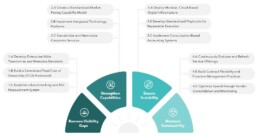
This six-step (Exhibit 4) roadmap provides a framework for developing the foundational capabilities that enable true organizational agility. By systematically addressing each of these abilities, healthcare leaders can transform their organizations from rigid, reactive entities into agile enterprises capable of responding quickly to market shifts while maintaining operational excellence.
Exhibit 4. The Task Blueprint for Agile Healthcare
Why Now?
Without a strong, structured foundation, true agility remains out of reach. That is exactly what the ‘Agility Enablement Menu’ offers: a flexible yet comprehensive framework that organizations can customize to fit their unique context. Whether starting small or tackling broader transformation, leaders can select what to address first, what comes next, and how to bundle efforts for maximum impact.
This is more important now than ever. The future of healthcare is not about simply reacting to change – it is about designing organizations that thrive on it. Imagine integrating acquisitions in months instead of years, launching new service lines with confidence, or shifting care delivery models overnight in response to a crisis. Envision implementing new payment models without disruption.
By investing in strong foundational capabilities today, healthcare leaders can build institutions that do not just weather disruption – they turn it into an advantage.