

Introduction to Agentic AI
Agentic AI adoption is accelerating at an unprecedented pace, driven by growing enterprise demand and rapid technological advancements. Over $2 billion has been invested in agentic AI startups in the past two years, and major players like Salesforce, Google, and Microsoft are actively building solutions (1). As costs decline and processing speeds improve, businesses are increasingly integrating AI agents in their workflows.
Unlike past AI adaptations that focused on data processing and insights, agentic AI introduces autonomous execution, handling multi-step processes with minimal human input. This shift marks a major break from previous AI implementations, which often delivered underwhelming productivity gains due to the need for human oversight. With agentic AI, tasks that previously required manual intervention, such as complex approvals, document processing, and customer service interactions can now be completed seamlessly.
This evolution mirrors past inflection points in technology adoption. Just as PayPal emerged as the critical enabler of eBay’s online marketplace by solving payments friction, agentic AI stands poised to redefine financial services by enabling intelligent, automated interactions across buying, fulfillment, and trust (2). In the future, agents could act as personal shoppers, negotiators, logistics coordinators, or payment routers, unlocking access to inventory, coordinating autonomous logistics, and executing programmable payments.
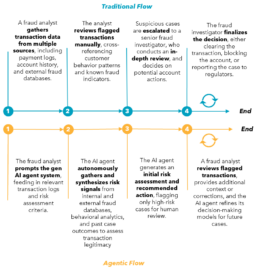
This shift is particularly impactful for financial services. Fraud detection systems can evolve from flagging suspicious transactions to autonomously responding to threats in real time. Risk assessment models, which have traditionally relied on human input for decisioning can be automated to handle significant data with speed and accuracy. As agentic systems become more commonplace, the lines between finance and automation are blurring, creating a moment of disruption reminiscent of the early internet era, only this time, powered by AI agents.
Exhibit 1. Agentic AI Workflow Execution (3)
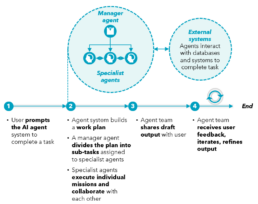
How Agentic AI Works
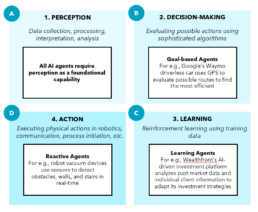
At the core of an AI agent’s functionality are 4 essential components: perception, decision-making, learning, and action. Perception allows AI agents to gather and process data from various sources, such as sensors, databases, and digital interfaces, creating a comprehensive understanding of their operating environment. Decision-making is powered by large language models and specialized reasoning techniques such as Self-Ask, ReAct, etc., which enable AI to evaluate options and coordinate complex tasks (4). Learning mechanisms form a continuous improvement loop — often referred to as a “data flywheel“ — where interactions generate feedback that enhances the system’s decision-making (5). Finally, through integrations with external tools and software via APIs, agentic AI can execute tasks in real time, bridging the gap between insight generation and autonomous action.
AI agents themselves can be categorized based on their level of interaction with their environment. Broadly, agentic AI falls into four key types: first, reactive agents operate based on predefined conditions without memory or learning capabilities, responding solely to immediate stimuli. Goal-based agents go a step further by considering future outcomes before executing actions, enabling more strategic decision-making. Learning agents leverage reinforcement learning and feedback loops to improve decision-making over time. Lastly, multi-agent systems involve multiple AI entities working together, enhancing coordination and accuracy but also introducing challenges in cost and error-tracing (6). These agents align with business needs, from simple automation to sophisticated AI-driven decision-making.
Exhibit 2. Different types of Agentic AI
Applications of Agentic AI
Exhibit 3. Illustrative Use-Case: Agentic AI-Powered Transaction Monitoring for Fraud Detection
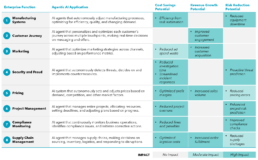
One of the most immediate applications of agentic AI is in customer experience (CX), where it enhances issue resolution, digital interactions, and sales processes. AI agents can process natural language descriptions of customer issues, compare them to past cases, and deploy solutions in real-time, reducing manual intervention. In marketing, agentic AI can generate high-quality, personalized content quickly, saving marketers hours per project and improving engagement. In sales, agents can autonomously follow up with leads, generate outreach emails and automate collections, making sales cycles efficient.
Beyond customer-facing roles, agentic AI is transforming internal operations by automating IT, HR, and security functions. Enterprises are deploying AI agents to conduct initial HR interviews, resolve IT issues, and enhance security through advanced video analytics. AI-powered agents in supply chain management analyze real-time data to optimize delivery routes, predict disruptions, and adjust inventory dynamically.
Ultimately, the businesses that stand to benefit the most from agentic AI are small and mid-sized companies, which are also the most eager adopters (7). These often operate with lean teams, balancing growth goals with limited resources, making automation a crucial factor in their ability to scale. Unlike large enterprises, which have the budget to build extensive internal automation solutions, mid-sized companies are in the sweet spot for agentic adoption: enough resources to deploy AI agents but still facing significant operational bottlenecks that automation can solve. Agentic AI allows them to streamline repetitive yet critical tasks.
Exhibit 4. Agentic AI Applications Across Enterprise Functions
Potential Integration Models
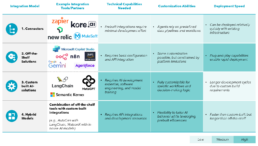
Integrating agentic AI into an organization requires a structured approach that balances ease of deployment, customization, and control. Businesses have four primary options for implementation:
1. Connectors: For enterprises that already have AI infrastructure in place, connectors offer a low-friction way to integrate agentic AI into their workflows. These pre-built integration tools enable AI agents to interact with databases, enterprise software (e.g., CRMs, ERPs), and cloud environments without requiring extensive system modifications. By leveraging APIs and middleware, connectors facilitate smooth data exchange, making AI deployment faster and reducing technical lift. However, connectors are limited by their predefined functionalities, meaning businesses may not have full control over how agents interact with enterprise systems. While they streamline integration, they are best suited for organizations that need incremental AI adoption rather than a fully autonomous, deeply embedded AI system.
2. Off-the-Shelf AI Solutions: Pre-built off-the-shelf AI platforms, such as Microsoft’s AutoGen, IBM’s WatsonX Orchestrate, OpenAI’s Operator, and Copilot Studio, provide ready-to-deploy AI agents that require little to no coding expertise. These allow businesses to quickly integrate agentic AI into their operations, particularly for use cases like customer service automation, and internal workflow optimization. The advantage of these platforms is their plug-and-play nature, enabling companies to experiment with AI-driven automation without heavy development costs.
However, off-the-shelf AI solutions can have rigid structures that limit customization. AI agents built on these platforms may not always align with industry-specific needs, and businesses have little control over the decision-making logic behind AI actions.
3. Custom-Built AI Agents: For organizations requiring greater control, custom-built AI agents provide the highest degree of flexibility. Using frameworks like LangChain, CrewAI, or MetaGPT, businesses can design agents to match specific process needs. Custom-built AI allows organizations to set their own guardrails, decision-making structures, and security protocols, reducing risks of data privacy issues. However, this approach requires substantial investment in AI development, infrastructure, and ongoing maintenance, making it more suitable for companies with dedicated AI engineering teams.
4. Hybrid Models: A number of enterprises are turning to hybrid AI integration, which combines pre-built AI solutions with custom-built enhancements. This model allows businesses to deploy off-the-shelf AI agents for common workflows, while building custom logic, security constraints, and advanced decision-making layers to ensure alignment with business needs. For example, a company might use Microsoft’s AutoGen as a foundation but overlay it with custom workflows built in LangChain for deeper process automation. Hybrid models balance speed and flexibility, allowing organizations to scale AI adoption without sacrificing control.
Exhibit 5. Choosing the Right Integration Approach
Roadmap to Integrating an Agentic AI Model
As agentic AI continues to reshape financial services, institutions must navigate a structured path to implementation. Beyond simply adopting AI, firms must ensure that these systems are secure, compliant, and operationally efficient, balancing automation with necessary oversight. A well-planned adoption strategy enables firms to maximize AI’s benefits while mitigating risks associated with regulatory requirements, data privacy, and decision accuracy.
Strategic selection of technology drives implementation: from data augmentation to cloud infrastructure to hardware to agent-building solutions, developing an ample tech stack to support agents up front is well worth the investment down the line.
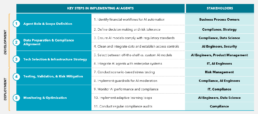
To achieve this, the implementation process can be broken down into key functional areas (8):
1. Defining the AI Agent’s Role and Scope
- Identify specific financial workflows where AI can drive automation, such as fraud detection, loan underwriting, claims processing, or customer service.
- Establish decision-making boundaries to ensure AI operates within regulatory and business constraints.
- Define risk tolerance for AI-driven decision-making, determining when human oversight is necessary (e.g., high-value transactions, credit approvals).
2. Data Preparation and Compliance Alignment
- AI agents require training on base data to develop the ability to make ‘decisions’ in response to real-time data feeds after deployment.
- Many use cases will not require further training beyond what the base LLM or off-the-shelf solution has undergone, but for those that do, retrieval-augmented generation (RAG) allows contextual data to be stored numerically in a vector database searchable by the primary reasoning engine (9).
- The perception layer of an agent might consist of an API endpoint or a live feed of GUI input and content (9).
- Ensure data privacy and security protocols align with regulatory standards (e.g., GDPR, CCPA, FINRA, OCC) and minimize unauthorized access to sensitive financial information.
3. Technology Selection and Development Strategy
- Decide between off-the-shelf AI solutions (e.g., AutoGen, WatsonX) or custom-built models (LangChain, Semantic Kernel) based on control, flexibility, and compliance
- Upgrade infrastructure as necessary, including hosting (e.g., AWS, Microsoft Azure), hardware (e.g., NVIDIA GPUs), and sunsetting batch processing for data that agents need to access in real-time
- Integrate AI agents through connectors to link them with banking systems, CRMs, and fraud detection platforms.
4. Testing, Validation, and Risk Mitigation
- Conduct scenario-based stress testing to ensure AI accuracy in high-risk applications like loan approvals and fraud detection.
- Implement guardrails (e.g., NVIDIA NeMo) to moderate AI outputs and prevent unauthorized decision-making.
- Appoint human overseer who can be pulled into the supervisory loop by moderator agent.
5. Deployment, Monitoring, and Continuous Optimization
- Monitor AI performance through continuous audit trails and reporting tools.
- Implement adaptive learning loops to refine AI decision-making based on real-world feedback and new regulatory updates.
- Conduct regular compliance reviews to ensure AI actions align with regulations and industry best practices.
Exhibit 6. Implementation Roadmap: Key Functions Required
Mitigating Risks Through Human Oversight
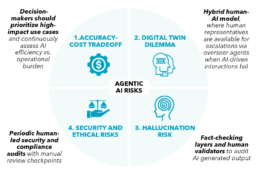
While agentic AI presents significant opportunities for automation and efficiency, its implementation comes with notable challenges. Deploying AI at scale stretches an organization’s compute resources, especially when training large language models. Adding an agentic layer compounds this strain, as these systems require ongoing processing power. AI agents actively engage with workflows, continuously pulling and processing data. This creates an inherent accuracy-cost tradeoff — the more sophisticated and responsive an agent is, the greater the computational burden, forcing companies to make strategic decisions about how and where to deploy these systems effectively (10).
Beyond resource constraints, system trust remains a major hurdle. AI agents operating independently introduce the “digital twin” dilemma — if a customer has a negative experience with an agent, the absence of human interaction can further erode trust. A poor AI-driven experience is not just an inconvenience; 70% of consumers say they would consider switching brands after a bad AI interaction (11).
Additionally, because these agents rely on LLMs at their core, they inherit the same hallucination risks, where AI generates misleading or inaccurate information with unwarranted confidence. This “black box” problem makes it difficult to verify AI-generated decisions.
Security and ethical risks further complicate agentic AI adoption. The more interconnected and autonomous these systems become, the greater the risk of adversarial attacks and misinformation propagation.
The dangers of unchecked automation were made clear in a 2023 UnitedHealthcare (UHC) class-action lawsuit, in which an AI model was programmed to automatically reject requests for coverage based on statistical predictions rather than actual patient needs, leading to patients being wrongly denied critical care (12). This case underscores the necessity of human oversight in AI-driven decision-making, particularly in sectors where errors have serious financial and medical consequences. Hallucination risk, for instance, can be monitored via a dual oversight model in which a supervisory agent flags content for escalation to human representatives.
Exhibit 7. Human Oversight as a Potential Risk Mitigator
In Closing...
Agentic AI is rapidly reshaping enterprise automation, and financial services firms stand to benefit significantly from its adoption. By integrating AI agents into critical workflows such as fraud detection, underwriting, and customer service, institutions can streamline operations, enhance decision-making, and improve customer experiences. However, given the regulatory complexity and high-stakes nature of financial transactions, a thoughtful implementation strategy is essential to balance efficiency with compliance and risk management.
Successful deployment requires defining the AI agent’s role, ensuring data security, selecting the right technology stack, and implementing guardrails for oversight. Financial institutions must invest in continuous monitoring, compliance audits, and adaptive learning models to maintain AI accuracy and reliability. The right mix of off-the-shelf solutions, connectors, and custom-built models can provide both speed and flexibility while ensuring AI aligns with institutional priorities.
As the financial industry moves toward increased automation, early adopters of agentic AI will gain a competitive edge by reducing operational costs and improving service delivery. However, AI agents must be deployed responsibly, with safeguards that prevent misinformation, bias, or security vulnerabilities. Institutions that take a measured approach, leveraging AI as a trusted, transparent, and accountable tool, will be best positioned to drive innovation while maintaining trust and regulatory compliance.
- Deloitte
- Fintech Nexus
- McKinsey
- Microsoft
- NVIDIA
- IBM
- LangChain
- Uptech
- Agaashe et. al., 2024
- “AI Agents that Matter,” Kapoor et al.
- Acquire BPO
- Estate of Gene B. Lokken et al. v. UnitedHealth Group, Inc. et al.