


A Lifecycle Framework for Trusted, AI-Ready Data
Executive Summary
This paper argues that the performance of artificial intelligence (AI) tools built on enterprise data is driven more by the quality and treatment of the data than by algorithmic sophistication. To achieve reliable AI, enterprises must treat data quality, privacy, and governance as core design elements – embedded at every stage of the data lifecycle rather than added as last-minute compliance checks. Early decisions about what data to collect and how it is defined, linked, and governed place hard limits on what models can see, learn, and safely do. Although enterprises possess vast amounts of data, it is often siloed, not designed for AI use, and governed in ways that emphasize risk mitigation after the fact. These conditions lead to issues such as inconsistent labels, bias, and privacy gaps that only surface when models fail. We propose a five-stage “data–AI lifecycle” that embeds governance throughout: acquisition, flow, structuring, annotation, and oversight. The paper outlines practical first steps: inventorying AI-relevant data, mapping governance gaps, assigning clear cross-functional ownership, and establishing monitoring and data lineage early.
Introduction
Organizations across industries increasingly recognize AI—and the data that powers it—as a source of competitive advantage. What distinguishes leaders from competitors is rarely superior algorithms, but their ability to convert enterprise data into reliable, operational information. As AI adoption expands, so does the volume and complexity of enterprise data, making the ability to operationalize data a core enterprise capability.
At its core, every AI system reflects the data used to train it. Consequently, the quality, structure, and governance of that data directly impact model performance and defensibility. Even the most sophisticated modelling techniques cannot compensate for fragmented sources, inconsistent definitions, or uncontrolled access to sensitive information.
Most organizations are not constrained by data scarcity. Enterprises today possess vast datasets generated across many sources. Yet this abundance creates a less obvious challenge: data is rarely designed with AI consumption in mind. Legacy architectures, siloed ownership, and governance models focused on compliance rather than enablement have produced environments where data is difficult to locate, risky to share, and poorly structured for training.
Successful AI adoption requires treating data governance and privacy engineering as integral to the entire data lifecycle, rather than as downstream controls. This paper presents a structured five-stage pipeline that embeds technical safeguards to make enterprise data AI-ready, and is intended for data leaders, chief data officers, and enterprise architects responsible for building scalable, AI-ready data infrastructure.
The Data-AI Interplay: AI Starts with Data
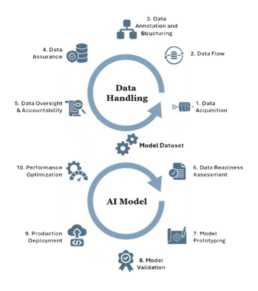
Exhibit 1 illustrates the relationship between data handling and AI model development, highlighting two interlocking cycles: one representing the data lifecycle and the other governing how models are built and refined using that data. Their connection underscores a critical reality: AI models do not operate independently of data processes but are continuously shaped by the data that feeds them.
Decisions made during data acquisition, flow, annotation, assurance, and oversight directly determine what information is available for learning and what constraints apply. The AI model cycle can react to these decisions, but it cannot undo them.
Long before a model architecture is selected, a set of assumptions is encoded in the data chosen and made available for learning. These early data decisions determine what a model can observe, which patterns it can generalize, and where it is likely to fail. The following irreversible choices are made well before any model engineering begins:
– The signals and patterns the model will learn from
– The breadth of populations, behaviors, and edge cases it will represent
– How entities are connected across time, systems, and contexts
– The extent to which sensitive attributes are preserved, obscured, or distorted
– The legal and ethical boundaries governing how the resulting model can be reused, shared, or deployed
Even an architecturally sound model trained on poorly structured or weakly governed data will underperform in production. Conversely, a simpler model trained on high-quality, privacy-aware data can deliver meaningful and reliable business impact.
Exhibit 1. The AI-Data Interplay
Governance in AI Data Handling
There is growing evidence that inadequate lifecycle governance materially degrades AI outcomes. When governance is not integrated early, data quality issues, inconsistencies, and uncontrolled transformations can propagate throughout an AI system, leading to model instability, bias, and unreliable outputs. Research by Sambasivan et al., published in the Proceedings of the 2021 CHI Conference, illustrates how weak governance practices give rise to “data cascades,” in which problems introduced during early data preparation amplify downstream errors across the AI pipeline (1). As a result, data governance is increasingly recognized as foundational to AI governance itself. Because AI systems learn directly from data, effective data governance is essential to mitigating downstream harms, including bias, privacy violations, and unsafe decision-making.
Consider a mid-sized financial services firm that developed a customer churn prediction model using data drawn from multiple internal systems. Because governance controls were applied only during model validation, a silent change in one source system’s definition of an “active customer” went undetected. The model was trained on inconsistent labels, leading to a measurable decline in accuracy that became apparent only after business performance suffered. By the time the issue was identified, root cause analysis required weeks of investigation – an outcome that could have been avoided had governance been embedded at the data acquisition and structuring stages.
Industry and policy bodies increasingly warn of the risks associated with siloed, late-stage governance. Studies show that traditional governance approaches struggle to keep pace with the speed and complexity of modern AI workflows. The OECD (2024) emphasizes that AI and privacy governance frameworks must converge and operate across the entire data lifecycle to prevent misalignment between ethical principles and operational practices (2).
When governance is bolted onto the end of data pipelines, organizations pay the price through rework, cost overruns, and preventable blind spots. Industry analyses consistently find that many AI initiatives fail to deliver expected value because governance frameworks remain fragmented and reactive rather than embedded from the outset. Together, these findings underscore that governance must be woven into every stage of the data lifecycle to ensure data is reliable, compliant, and fit for AI use.
Governance as a Design Principle
If governance is no longer treated as a downstream control, the question becomes how it should be operationalized within data pipelines. The required shift is not one of additional policy, but of architectural intent. In AI systems, governance must be expressed through design decisions that constrain how data is acquired, transformed, and used well before models are trained. In this sense, governance becomes inseparable from data engineering.
When treated as a design principle, governance evolves across the data lifecycle. Early in the pipeline, it is definitional—establishing the conditions under which data may exist through mechanisms such as purpose binding, provenance preservation, and sensitivity classification. As data begins to flow, governance becomes structural, determining how data is shared, which transformations are permitted, and how access is enforced through embedded controls that balance usability with risk management.
Once data is converted into learning material, governance becomes semantic, shaping meaning through annotation and structuring decisions that define entities, relationships, and identity handling—choices that directly influence bias, privacy exposure, and model behavior and cannot be fully corrected later.
Further downstream, governance takes on a verification role, expressed through measurable checks on quality, statistical stability, and safety to validate that earlier design decisions hold under real data conditions. Finally, once AI systems are operational, governance becomes adaptive, relying on oversight mechanisms for traceability, monitoring, and corrective action to ensure systems continue to behave within expected bounds as conditions change.
Taken together, these shifts illustrate why governance cannot be reduced to a single checkpoint. In AI, governance isn’t applied later – it actively shapes how data is created, transformed, and used at every stage of the lifecycle. Implementing this approach is not without challenges—organizational resistance, legacy systems, and skill gaps in areas such as privacy engineering and data quality automation are common but the cost of addressing these issues early is consistently lower than retrofitting governance once models are in production or upon a compliance failure.
Data-AI Lifecycle: A Practical Operating Model
1. Data acquisition
Data acquisition is the first and most foundational stage of the data–AI lifecycle, where governance must be enforced before data enters the system. Without strong physical, legal, and contextual constraints at ingestion, organizations accumulate large volumes of unanalyzed and unclassified data, commonly referred to as dark data. IBM estimates dark data accounts for nearly 90% of data generated by sensors and operational systems, creating unnecessary storage costs and downstream complexity (3).
Governance at this stage is fundamentally preventive. It determines whether data should be ingested at all, in what form, and under what constraints. When acquisition governance is weak, data quickly becomes a liability; when it is effective, data enters the pipeline usable, compliant, and traceable from the outset.
To operationalize governance at the acquisition stage, organizations should treat data ingestion as a controlled gate with explicit decision rights and enforcement checkpoints:
a) Purpose, legality, and consent validation: Each dataset must be explicitly tied to a defined business purpose and AI use case, with a verified legal basis for processing. This includes validating applicable regulatory requirements (e.g., GDPR, CCPA, HIPAA), consent scope, and contractual permissions for third-party data, thereby preventing speculative or non-compliant collection.
b) Sensitivity classification and tagging: Data should be classified at ingestion using a standardized taxonomy (e.g., public, internal, confidential, regulated/PII). Early classification informs all downstream controls, reducing privacy risk and enabling consistent enforcement.
c) Initial quality and format checks: Basic validation such as schema compatibility, data type correctness, and transformation readiness should be applied before data enters core pipelines. These early filters prevent low-quality data from propagating and reduce costly remediation later.
d) Ownership and accountability assignment: Clear roles must be established at ingestion, including data owners (governance accountability), data stewards (quality and compliance), and data custodians (technical handling). This formalizes responsibility and enables escalation, auditing, and lifecycle oversight.
2. Data flow
Once data has been acquired, governance must shift from deciding what data may exist to controlling how data is allowed to move. In modern AI systems, data continuously traverses storage layers, analytics platforms, and machine-learning pipelines, and without governance embedded into these flows, sensitive data can propagate into unintended environments, transformations can silently alter meaning, and access controls can fragment across tools. Effective data-flow governance is therefore not about restricting movement, but about engineering enforceable constraints directly into pipelines so data can move safely, consistently, and traceably as it supports analytics and AI workloads.
End-to-end governance at the data flow stage can be operationalized through the following mechanisms:
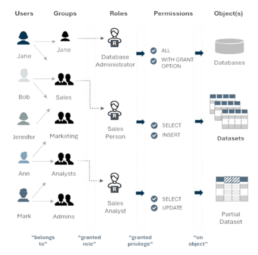
a) Policy-driven access control through roles and groups
In modern data pipelines, access control governs not only who can read data, but how it moves, in what form, and under which conditions. In AI environments, access logic must be embedded directly into data-flow architecture to support experimentation while protecting sensitive attributes. This is achieved through role- and attribute-based access control, fine-grained permissions, and dynamic masking, where access is determined by role and contextual signals such as data sensitivity, environment, and approved purpose, and scoped to specific datasets or fields. Format-preserving anonymization further protects sensitive values as data crosses pipeline boundaries without breaking schemas or tooling, allowing a single governed dataset to safely serve multiple consumers while enforcing least-privilege access and avoiding duplication.
b) Structural safeguards: schema enforcement and lineage
Beyond access and anonymization, governance at the data-flow stage requires structural safeguards that preserve meaning and traceability as data evolves. Explicit schema contracts and transformation guardrails prevent silent structural changes that could alter the semantic interpretation of data used for AI training. Embedded lineage and traceability record every data movement and transformation, capturing sources, processing steps, and destinations. These controls provide the auditability, explainability, and root-cause visibility required to diagnose unexpected model behavior, respond to incidents, and maintain trust in AI systems over time.
Exhibit 2. Role & access control
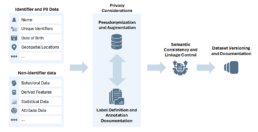
3. Data structuring and annotation
As data moves beyond ingestion and controlled flow, it must be transformed into learning material. AI models do not learn from raw tables or files, but from representations- entities, features, labels, and relationships – that define what the model can observe and infer. This stage is therefore where operational data becomes an explicit modeling input, and where assumptions about the world are encoded directly into datasets. From a governance perspective, this stage is uniquely sensitive because it governs meaning rather than movement: decisions about identity representation, linkage, labeling, and context shape bias, fairness, and generalization in ways that are often irreversible. Errors introduced at this stage are rarely detectable through compliance checks and typically surface only later as skewed predictions, brittle models, or unexpected behavior in production.
a) Entity definition and boundary setting: The first step in structuring data for AI is defining what constitutes an entity and where its boundaries lie – such as individuals, accounts, households, sessions, devices, or composite constructs. These decisions determine how identity propagates through the system and constrain the level of inference a model can make, making entity definition a foundational governance choice
b) Identity protection through pseudonymization and synthetic data: Identity governance at this stage is enforced through pseudonymization and, where appropriate, synthetic data augmentation. Direct identifiers are replaced with synthetic identifiers that preserve relationships across records and over time while removing explicit exposure of sensitive identity; mappings are tightly controlled and isolated from analytical environments. Synthetic data can further augment real datasets with statistically similar but artificial records, reducing re-identification risk in sensitive segments and improving representational balance where real data is limited or biased.
c) Label and feature governance for semantic consistency: Labels and features jointly define the ground truth and signals that AI models learn from, making them among the most governance-critical artifacts in the pipeline. This requires explicit definition of label meaning, derivation logic, and validity assumptions, along with disciplined control over feature construction. Annotation and feature engineering processes must be documented, auditable, and consistent over time to prevent silent shifts in meaning. Without semantic governance, derived features can amplify bias, leak sensitive information, or encode proxies for protected attributes, leading to unstable or misleading model behavior across datasets, time windows, and environments.
d) Relationship and linkage control: Structuring often requires linking entities across datasets, such as customers to transactions or users to devices, which increases analytical power but also privacy exposure. Governance requires deliberate control over which relationships are necessary for the modeling objective and which should be restricted, aggregated, or prohibited to limit inference risk.
e) Dataset versioning and documentation: Once structured and annotated, datasets should be treated as versioned data products rather than static artifacts. Each version must be documented with entity definitions, labeling logic, feature sets, and applied privacy transformations to support reproducibility, auditability, and controlled evolution over time.
Exhibit 3. Governance overview of the structuring and annotation phase
4. Data assurance
As data transitions from structured learning material into model training and deployment pipelines, governance must shift from design-time controls to verification and enforcement. This stage ensures that data is not only usable but safe, stable, and reliable for learning.
Assurance is primarily concerned whether data continues to meet defined expectations for quality, integrity, privacy, and fairness. This stage is especially critical in AI systems because models internalize statistical properties of data. Undetected errors, drift, or bias are absorbed into model behavior and can propagate into production outcomes.
From a governance perspective, this stage is the most error-prone because failures are often probabilistic rather than deterministic. Data may appear syntactically valid while being statistically unsound, biased, or risky. Effective governance requires continuous validation vs. static controls.
a) Data quality validation and threshold enforcement: Establish explicit quality metrics for datasets used in pipelines, including completeness, accuracy and consistency. These metrics must be enforced automatically prior to model training or refresh cycles. Governance here ensures that datasets failing to meet thresholds are quarantined or flagged, preventing silent degradation.
b) Statistical integrity and drift detection: Governance must extend beyond row-level validation to statistical behavior. This includes monitoring distribution shifts & over time. By embedding drift detection into data pipelines, organizations can identify when data no longer represents the conditions under which models were trained.
c) Bias and fairness assessment: Governance at this stage must explicitly evaluate representational balance and outcome disparities across segments. This requires testing datasets for skew, proxy variables, and uneven coverage prior to model training. Fairness checks must be tied back to established entity definitions and labeling logic.
d) Privacy risk and re-identification testing: While pseudonymization and anonymization are applied earlier, data assurance validates that these protections remain effective in practice. This includes assessing re-identification risk, linkage risk across datasets, and exposure introduced through derived features.
e) Dataset certification for model use: Once assurance checks are complete, datasets should be certified as “fit for AI use” for a defined scope and time window. This certification acts as a governance contract between data producers and model consumers, ensuring that models are trained only on data that meets documented safety and quality standards.
Exhibit 4. Multi-stage validation checks across the data assurance lifecycle

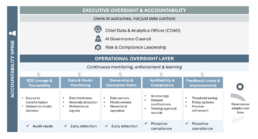
5. Data oversight and accountability
The final stage of the data cycle ensures that governance remains effective over time as data, models, and business conditions evolve. In AI systems, governance that is not continuously monitored degrades silently, even when initial controls are well designed. This stage connects data behavior, model outcomes, and organizational responsibility into a feedback loop, enabling organizations to explain decisions and respond to incidents at scale.
As AI systems move into core business operations, organizations are formalizing accountability at the executive level. Gartner reports that more than 70 percent of Chief Data and Analytics Officers are now responsible for AI strategy and operating models, reflecting a shift from data stewardship to lifecycle oversight (4). From a governance perspective, oversight is where accountability becomes enforceable. It ensures that when AI systems fail, organizations can trace why, where, and who is responsible.
A practical oversight and accountability framework includes the following features and capabilities:
a) End-to-end lineage and traceability: All data used in AI systems must be traceable from source through transformation, assurance, and model consumption, to enable reconstruction of how outputs were produced.
b) Continuous monitoring of data and model behavior: Governance at this stage requires ongoing monitoring of both input data and downstream model performance. Oversight mechanisms ensure that deviations from expected behavior are detected early rather than discovered through business impact or customer complaints.
c) Ownership, stewardship, and escalation paths: Each role defined across the lifecycle must have explicit responsibilities for monitoring, approving changes, and responding to issues.
d) Auditability and compliance evidence: Oversight ensures that governance decisions and controls leave an auditable trail (e.g., evidence of data access). In regulated environments, this capability enables organizations to demonstrate compliance proactively rather than reconstructing evidence retroactively.
e) Feedback and continuous improvement loops: The final function of oversight is learning. Insights from incidents must feed back into upstream stages to close the governance loop and prevent repeated failures driven by the same root causes.
Exhibit 5. Rudimentary AI governance operating model
Getting Started
Organizations seeking to operationalize lifecycle governance should begin by grounding the framework in a small set of practical actions that create transparency, clarify ownership, and embed governance directly into data pipelines. The steps below outline an initial path forward:
1. Conduct a data inventory: Identify where AI-relevant data resides, who owns it, and what governance controls (if any) are in place.
2. Map governance gaps to lifecycle stages: Use the five-stage framework to assess where current practices fall short and where risk is concentrated.
3. Pilot embedded controls in one pipeline: Select a single AI use case and implement governance controls across its full data lifecycle, from acquisition through oversight.
4. Establish cross-functional ownership: Assign accountable roles (data owners, stewards, custodians) and define escalation paths before scaling.
5. Instrument for feedback: Build monitoring and lineage capabilities early so governance effectiveness can be measured and improved over time.
Conclusion
AI systems fail not because of flawed models, but because the data shaping them is poorly governed, weakly structured, or misaligned with purpose. Sustainable AI performance depends less on algorithmic sophistication than on disciplined data handling across the entire lifecycle.
By operationalizing governance throughout the data lifecycle, organizations can transform existing data assets into AI-ready inputs that are reliable, privacy-aware, and fit for reuse. In this model, governance becomes an enabler of experimentation and scale – not a compliance burden.
Organizations that succeed in an AI-driven economy will be those that engineer data systems capable of learning responsibly over time. The opportunity is immediate, and the time to act is now.
- Sambasivan, N., Kapania, S., Highfill, H., Akrber, D., Paritosh, P., & Aroyo, L. (2021). “Everyone wants to do the model work, not the data work: Data Cascades in High-Stakes AI.” Proceedings of the 2021 CHI Conference on Human Factors in Computing Systems. https://doi.org/10.1145/3411764.3445518
- Organisation for Economic Co-operation and Development (OECD). (2024). AI, data governance and privacy (OECD Artificial Intelligence Papers). OECD.
- Vinay Rao. (2025). Extracting dark data IBM Developer. Articles. IBM
- Gartner. (2025). Gartner Survey Finds 70% of CDAOs Are Responsible for AI Strategy and Operating Model. Information Technology Press Release. Gartner.