

Reimagining Resiliency with AI
In February 2024, hackers launched one of the most devastating ransomware attacks in U.S. history. Their target was Change Healthcare, one of the nation’s largest healthcare payment processors. The breach crippled billing, claims, and pharmacy operations nationwide. Patient care was disrupted. Cash flows across hospitals, insurers, and pharmacies were unable to operate. Because Change Healthcare is owned by UnitedHealth Group, the outage cascaded through the broader healthcare system, exposing data of ~190 million Americans (1). UnitedHealth spent more than $2.3 billion on response and recovery (2). The root cause was simple but costly: the absence of a multifactor authentication control on a remote access portal. This incident shows how even a single lapse in cyber hygiene can result systemic risk.
Risks of this nature extend far beyond one company or industry. Cyberattacks surged 47 percent globally in Q1 2025, compared to the year before. The average incident cost rose to $4.9 million (3). However, the real figure is like higher: many breaches are handled quietly to avoid reputational damage or regulatory scrutiny. Insurers often play a direct role in this approach of attack handling. A 2024 study found that ~40 percent of ransomware victims paid the ransom, frequently with their insurer’s involvement and approval (3).
Healthcare systems are especially vulnerable. In 2024, 2,124 major ransomware attacks were recorded, but only 278 disclosed (4). This gap masks the true scale and cost of attacks in one of the economy’s most critical sectors.
As threats escalate, organizations face growing pressure to strengthen defenses and prepare for breaches. In the recent past, many are turning to artificial intelligence (AI) to gain an edge. Traditional defenses, such as signature-based detection and perimeter-focused controls, are no longer effective. They struggle against zero-day attacks, insider threats, and multi-stage intrusions. Static rules and manual processes cannot keep up with the increase pace of attack.
AI changes the equation. Modern systems can detect threats faster, automate responses earlier, and surface vulnerabilities before they are exploited. These capabilities give organizations a chance to improve resilience and shorten response times. Yet AI is not a silver bullet. As companies embed AI into their security strategies, they also introduce new vulnerability vectors. These technologies demand continuous oversight, investment, and vigilance across every industry.
AI in Cybersecurity: A Double-Edged Sword
AI is transforming the cyber threat landscape in ways that are both promising and challenging. While AI is enhancing defenders’ ability to detect, respond to, and mitigate cyber threats faster and more effectively than ever, it is also arming bad actors with more sophisticated and scalable kinds of attacks. In 2024, Microsoft’s telemetry data revealed a 1,100 percent increase in password attacks compared to 2021 and an escalation from 579 attempts per second to 7,000 per second (5). These cyberattacks are often autonomous and self-directed, carried out with minimal human oversight and adapt dynamically to bypass defenses. As a result, ransomware and phishing campaigns are not only more frequent but also often hyper-personalized using deepfake and gen AI technologies.
The influence of AI extends to nearly every aspect of the threat landscape which can be categorized into three broad categories: infrastructure-specific attacks, zero-day vulnerability exploits, and social engineering threats.
A. Infrastructure-Specific Attacks
AI enables attackers to launch fast, sophisticated, targeted campaigns, especially against organizations that have complex cloud and hybrid IT environments. In the cloud, AI-driven attacks can bypass access controls, impersonate users, and move laterally across systems at great speed. In the past year, breakout time (i.e., how long it takes for a threat to move laterally across the network) dropped to an all-time low, in some cases falling to only 51 seconds (6).
For example, in late September 2023, Johnson Controls, a global leader in security systems, suffered a devastating ransomware attack. Threat actors initially accessed its internal IT network through systems in the company’s Asia offices, and the attack quickly spread laterally across the network infrastructure. The nefarious actor deployed ransomware agents to VMware ESXi servers and exfiltrated more than 27TB of sensitive data, including building layouts and security configurations, before issuing a $51M ransom demand (7). The incident forced large portions of the company’s IT systems to be shut down and resulted in $27M in remediation costs, not including potential long-term reputational and operational damage (8).
B. Exploitation of Zero-Day Vulnerabilities
Malicious actors increasingly leverage AI to find and exploit zero-day vulnerabilities (i.e., flaws in software or systems that are unknown to the vendor and therefore remain unpatched). By harnessing AI, attackers can scan vast amounts of code and system configurations at great speed, uncovering weaknesses before defenders are even aware of them. Large-scale data analysis fueled a surge, from 37 percent in 2023 to 44 percent in 2024, in exploitations of zero-day vulnerabilities that targeted enterprise-specific technologies (9). The automation enables attackers to develop and deploy such exploitations at substantial speed and scale.
In response, companies are reimagining cybersecurity by embedding advanced, self-learning AI into every layer of defense. For instance, new AI-driven orchestration engines like IBM’s Autonomous Threat Operations Machine (ATOM) now automate much of the threat triage, investigation, and remediation process. Using agentic AI, IBM’s platform processes structured and unstructured data (e.g., blogs, threat reports, real-time network activity) to detect subtle indicators of compromise and attack patterns. Early adopters of AI systems like ATOM report a 50 percent reduction in incident-resolution times, suggesting that AI-driven autonomy is rapidly becoming essential for dealing with increasingly sophisticated and fast-moving threats (10).
C. Social Engineering Threats
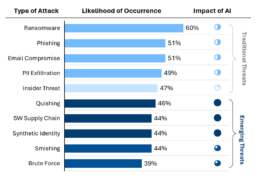
Phishing has evolved from crude spam emails to sophisticated, multi-faceted threats. Through generative AI and machine learning, AI-enabled phishing uses a range of tactics (i.e., via personalized data), vishing (voice phishing), smishing (SMS phishing), quishing (credential theft via QR codes), and deepfake phishing, where AI generates fake videos or voice messages supposedly sent from trusted individuals. Between the first and second half of 2024, email-based phishing attacks grew 202 percent, vishing attacks grew 442 percent, and quishing attacks grew 703 percent (11,12). More than 82 percent of phishing emails today incorporate AI to enhance their credibility and evade traditional detection (13). Exhibit #1 further illustrates how AI is shaping modern attacks, including phishing, ransomware, business email compromise and more.
In response, leading technology companies are operationalizing AI at scale to strengthen their defenses against the ever-increasing number of cyberattacks. For example, Microsoft detected more than 30 billion phishing emails targeting its customers in 2024, a number that would be impossible for human analysts to manage alone (14) To address this issue, Microsoft launched Security Copilot, a suite of AI agents designed to help detect, investigate, and respond to security incidents with speed and precision. These AI agents automate such routine security tasks as triaging phishing alerts, analyzing logs, and correlating threat intelligence, thus reducing the manual workload for security analysts. In one case study, Security Copilot’s AI-driven investigation of a phishing campaign took less than 3 minutes, compared to the typical 40 minutes required for manual analysis. By automating response workflows, Microsoft’s mean time to respond shrank from hours to minutes, enabling it to contain threats before they escalate.
Exhibit 1. Impact of AI on Cyber Attacks
With the global cost of cyberattacks projected to reach $10.5 trillion in 2025, organizations across all sectors recognize that keeping pace with AI-enhanced threats demands strategically integrating AI into their defensive operations (15). However, as companies race to strengthen their cybersecurity, they are contending with a threat landscape that is both more pervasive and substantially more expensive than ever. This has catalyzed a shift in strategy that positions AI less as an optional enhancement than as an essential component of security architecture.
Exhibit 2. AI-Enabled Incident Management Lifecycle
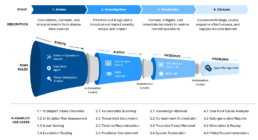
Central to this shift is the need to integrate AI into all of the incident-management lifecycle, the end-to-end process organizations follow to identify, analyze, resolve, and learn from cyber threats. This lifecycle typically contains four key phases: incident intake, investigation, resolution, and closure (see Exhibit 2). By embedding AI into each stage, organizations can streamline workflows, accelerate response times, and enhance decision-making with real-time insights.
The next section explores how AI is being applied across each phase of the incident lifecycle to strengthen operational resilience and minimize the impact of cyber incidents.
Use Cases Across Cybersecurity Lifecycle
Amidst growing numbers of incidents and an evolving threat landscape, AI is rapidly transforming how organizations manage incidents by embedding intelligent decision-making and automation into their critical response processes.
This section explores four key use cases of AI in today’s incident-response lifecycle: intelligent intake systems that classify and prioritize threats as they emerge, automated vulnerability analysis that continuously scans for zero-day threats, knowledge retrieval that surfaces relevant prior incidents and solutions, and root cause discovery that pinpoints the issues that drive recurring threats. Together, these capabilities show how AI supports more agile, informed responses and builds a foundation for long-term resilience and operational confidence.
1. INTAKE
Effective incident intake serves as a critical control point in the incident lifecycle. If executed well, this initial stage can contain potential threats early, reduce manual effort, and prevent minor issues from escalating. In practice, however, most organizations face a fragmented and reactive intake process that is marked by excessive numbers of alerts, inconsistent reporting, and limited context. Incident response teams are inundated with an average of more than 10,000 security alerts daily from monitoring tools, user reports, and threat intelligence feeds, the majority of which are often duplicate reports, low-priority issues, and false positives that obscure genuine threats, strain analysts’ limited analyst capacity, delay response times, and increase exposure (16). As a result, a typical workday finds security operations center (SOC) analysts able to review only 49 percent of the alerts that require attention (17).
AI offers a powerful response to these challenges by automating the classification, enrichment, and prioritization of issues and alerts. AI-driven systems can correlate related events, assess their likely impact, and route them with speed and precision. With 30 percent growth between Q1 and Q2 of 2025 in the adoption of AI in monitoring solutions, the integration of AI in as part of ITSM is no longer a futuristic add-on (18).
Use Case: 1.1 Intelligent Intake Channels
Incidents can originate from a wide range of sources, including automated alerts from detection tools, raw telemetry and log data, external threat intelligence feeds, and manually submitted reports from end users. This variability creates a fragmented intake process that could be addressed via enterprise-wide intelligent intake channels. These channels serve as AI-powered entry points that unify and interpret issues before they become incidents.
Using natural language processing (NLP), AI-powered incident-management systems parse unstructured reports to extract the attributes of key incidents, while machine learning models classify and prioritize alerts based on historical patterns and risk context. For example, if a user reports a phishing attempt, the system can flag it, check for similar incidents, and route it to the team that has relevant assets and has dealt with related cases. This approach streamlines the intake process, reduces noise, and ensures that security teams get clear, actionable information so they can respond quickly.
Benefits: Reduction in Ticket Volume: By leveraging AI to process and resolve routine or low-risk incidents automatically, organizations can significantly decrease the volume of incidents that require manual review. AI can handle an average of 51 percent of incoming incidents without human supervision, enabling teams to place their focus where it is most needed (19). This reduction in the number of tickets enhances both efficiency and visibility, as organizations face an average of around 10,000 false positives per week, while 12,000 genuine threats go undetected because of the number of signals (20). Intelligent intake eliminates unnecessary noise and redirects analysts’ attention to risks that might be overlooked otherwise, increasing productivity and detection accuracy.
Benefits: Cost Savings: In addition to reduced ticket volume, organizations that leverage AI-enabled tools to support intelligent intake and auto-resolution have reported up to 40 percent savings in the cost of IT support, largely due to reduced reliance on human analysts for initial triage and resolution (21). By filtering out low-complexity incidents and enabling autonomous handling of known issues, AI intake systems can serve as a powerful cost-containment strategy.
By integrating AI-powered intelligent-intake channels into incident management workflows, organizations can minimize false positives and enrich incident data at the source, leading to substantial cost savings and heightened visibility into genuine threats. This results in a more focused, efficient, and proactive incident response process, empowering teams to respond faster and more effectively.
2. INVESTIGATION
The investigation phase is where a security incident’s true nature, origin, and scope are revealed. During this stage, organizations move beyond initial detection to analyze affected systems systematically, enrich incident data with contextual intelligence and reconstruct the events that led to the compromise. Effective investigation hinges on several critical activities: scanning affected assets for known vulnerabilities and risk levels, integrating threat intelligence into its historical context, mapping the attacker’s movements through timeline reconstruction, and developing targeted containment strategies based on lessons learned from past incidents.
However, many incident management teams face such challenges as fragmented data sources, the need to gather evidence manually, and the sheer complexity of modern attacks. By leveraging AI-powered tools throughout the investigation phase, organizations can automate scans for vulnerability, enrich incident records rapidly, and generate comprehensive attack timelines, thus enabling faster, better coordinated, and more effective containment. This intelligent, data-driven approach is essential in minimizing attacks’ impact and ensuring a resilient response to evolving threats.
Use Case: 2.1 Scanning and Flagging AI-Driven Vulnerabilities
After an incident is detected, scanning affected or potentially affected systems for known vulnerabilities is performed to assess risk and prevent further compromise. AI-powered vulnerability-scanning solutions automate this process by analyzing networks, endpoints, and applications rapidly to identify misconfigurations, outdated software, and exposures linked to known threats. These tools reference vulnerability databases (e.g., the CVE repository) to flag risk levels in real time and provide incident response teams with actionable intelligence. Traditional vulnerability-scanning tools often rely on highly manual processes, particularly for interpreting scans’ outputs, filtering false positives, and correlating vulnerabilities that are critical to the firm’s assets and that affect their businesses. As IT environments grow more complex with the proliferation of cloud services, containers, IoT devices, and remote endpoints, the number of vulnerabilities detected can easily overwhelm incident management teams. As Exhibit 3 shows, the number of vulnerabilities identified in 2024 was 40 percent higher than those identified in 2023, with 2025 on pace to surpass 2024 substantially (22). This increased number of incidents often leads to fatigue and slower response times, especially in less mature environments, where manual triage and investigation delay remediation and increase the risk of exploitation. Traditional scanning for vulnerabilities (e.g., fixed schedule scanning) cannot keep pace with this rapid expansion, leaving organizations exposed to evolving threats.
Exhibit 3. Severity of Identified CVEs (2016 – 2025)

In response, organizations are turning to AI to enhance and accelerate their vulnerability-management efforts. After detecting an incident, AI can automatically initiate targeted scans across the affected systems to identify potential entry points or weaknesses that may have been exploited. This intelligent, post-incident scanning improves the accuracy and speed of investigation and ensures that remediation efforts are focused and effective. Reflecting organizations’ growing reliance on AI, the vulnerability-scanning market is projected to expand from $3.12 billion in 2023 to $7.57 billion by 2030, underscoring the critical role AI now plays in cybersecurity operations.
Benefits: Enhanced Threat Containment: AI enables rapid, automated scanning of compromised or at-risk systems, allowing organizations to identify and contain vulnerabilities significantly faster than manual methods can. This enhanced speed reduces windows of opportunity for attackers and limits an incident’s potential impact, thus helping organizations mitigate data loss, service disruptions, and financial damage. Organizations that used AI-powered security systems in 2024 were able to detect and contain breaches 108 days faster than those not employing AI in their resiliency posture (23).
Benefits: Cost Savings: Implementing vulnerability-scanning immediately after an incident is detected also offers substantial cost savings. By rapidly identifying and prioritizing vulnerabilities in affected systems, businesses can prevent further exploitation and minimize downtime and financial losses. On average, organizations that use AI to scan for vulnerabilities report avoiding costs of approximately $1.76 million per breach (24).
By integrating AI-driven vulnerability-scanning into post-incident responses, organizations strengthen their security postures and achieve operational and financial benefits. This proactive approach is essential to organizations’ ability to be resilient in an increasingly complex and dynamic threat landscape.
3. RESOLUTION
The resolution phase marks the shift from investigation to neutralizing threats and restoring normal operations. During this stage, teams draw on institutional knowledge to apply proven strategies, orchestrate containment, eradicate malicious activity, and ensure full system recovery. Effective resolution begins by leveraging insights and best practices from past incidents to avoid repeating mistakes. Containment-orchestration tools then identify potential paths for lateral movement and recommend targeted quarantine measures to prevent further spread. Automated threat eradication accelerates the removal of malicious artifacts through timely deployment of software patches, configuration changes, and new security controls. Finally, system restoration verifies that affected assets are thoroughly cleaned, patched, and returned to their normal performance.
By using AI-driven solutions throughout this phase, organizations can streamline response efforts, reduce manual workloads, and achieve a fast, reliable return to business as usual. This comprehensive approach is essential to minimizing downtime, lowering residual risk, and strengthening organizational resilience.
Use Case: 3.1 AI-Powered Knowledge Retrieval
The use of institutional knowledge in responding to incidents remains largely segregated across disparate systems, including post-incident reports, runbooks, technical documentation, tribal knowledge held by senior analysts, and lessons learned from past investigations. This fragmentation creates challenges in knowledge retrieval that can be addressed by AI-powered knowledge systems as intelligent repositories that unify and contextualize organizational learning.
Unlike traditional search tools that rely on static keyword-matching, modern AI systems understand incidents contextually and link emerging threats to past cases based on tactics, techniques, and procedures (TTPs), affected systems, or even latent root causes. By embedding intelligence into knowledge management, organizations move beyond reactive firefighting to proactive resilience, where every resolved incident strengthens future defenses.
Incident management teams often spend considerable time searching manually for past incidents, remediation steps, or contextual threat intelligence, which delays response and increases the risk of misdiagnosis. AI-powered knowledge-retrieval systems address this challenge by instantly surfacing relevant historical incidents, resolution playbooks, and threat actors’ patterns to enable faster, better-informed decision-making.
Using NLP and semantic search, AI analyzes unstructured incident reports, security bulletins, and internal documentation to identify connections between new and past threats. Machine learning models rank results based on relevance, while generative AI can summarize key remediation steps and suggest analogous cases. For recurring issues, the system may recommend pre-approved mitigation actions, thereby reducing investigation time. In addition, when new incidents are continually indexed, the knowledge base evolves in real time, so analysts can always access the latest intelligence. Thus, static documentation repositories are transformed into dynamic, AI-augmented decision-support tools that accelerate resolution and reduce human error (25).
Benefits: Reduction in Mean Time to Resolution (MTTR): AI-powered knowledge retrieval cuts through noise by instantly surfacing contextually relevant past incidents, reducing the ”time to understanding” in investigations. By automatically surfacing analogous past incidents, proven resolution playbooks, and expert-crafted mitigation steps, these systems compress critical phases of the response lifecycle. Organizations that leverage AI-augmented knowledge platforms resolve recurring threat categories 50–65 percent faster than those that do not, while containment workflows are 2.5 times faster when automated playbooks are triggered for high-confidence matches (26). For novel attacks, semantic correlation of tactics (e.g., linking zero-day exploitations to past incidents with analogous chains of execution) reduces diagnostic time by 60 percent (27).
Benefits: Optimized Signal-to-Noise Ratio in Security Operations: Knowledge-retrieval capabilities go beyond basic information access to enhance security incidents’ clarity and prioritization and improve responses’ effectiveness. AI-powered systems leverage accumulated institutional knowledge to filter and prioritize incoming incidents contextually, creating a continuous learning mechanism that refines detection accuracy over time.
Recent industry data shows that AI-driven solutions can reduce false positives and noise by as much as 65 percent, thus helping incident management teams distinguish between true threats and false alarms and improving operational efficiency (28). As the system’s knowledge base grows, its capabilities for incident triage are refined, supporting faster and more accurate decision-making throughout cyber resiliency’s lifecycle. This sustained improvement marks a shift from reactive incident handling to proactive threat identification that strengthens organizational resilience through continuous refinement of detection processes.
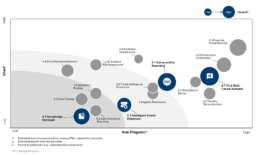
Enabling AI-powered knowledge retrieval can be both low effort and low risk, but can drive substantial benefits (see Exhibit #4). By unifying fragmented institutional knowledge and applying advanced AI-driven retrieval, organizations can transform their security operations from reactive to proactive. These intelligent knowledge systems accelerate incident response, improve prioritization, and foster a culture of continuous learning, thus ensuring that every investigation contributes to strengthening future defenses. As attack surfaces expand and threats evolve, harnessing AI-powered knowledge management is essential for building lasting cyber resilience and empowering analysts to make fast, smart decisions.
Exhibit 4. Estimated Effort, Risk, and Impact of Implementing AI on Use Cases Across Incident Management Lifecycle
4. CLOSURE
Incident closure is a critical yet often overlooked component of effective incident management. When handled well, effective post-incident review serves as a foundation for continuous improvement, whether by uncovering the root causes of security events, identifying process gaps or reinforcing organizational resilience. However, in practice, incident reviews are frequently rushed or inconsistently executed and see limited integration into a broader security strategy. As a result, key insights are lost, underlying issues remain unaddressed, and policies often go unchanged. AI can help address these challenges by introducing consistency, depth, and scale to incident-closure activities. AI tools can power root cause analysis by identifying patterns in incident data, generating post-incident reports with minimal manual input, simulating attack scenarios for resiliency replay, and surfacing tailored policy recommendations that are based on historical context. Together, these capabilities transform incident closure from a check-the-box task to a strategic driver of continuous improvement.
Use Case: 4.1 Root Cause Analysis
AI-powered root cause analysis transforms the incident response cycle by leveraging machine learning on historical incident data such as system logs, incidents, and post-mortems to surface systemic vulnerabilities and attack patterns that manual investigations frequently overlook. By accelerating investigations and enabling a shift from a reactive firefighting to proactive prevention, AI can substantially enhance organizational resilience.
Benefits: Autonomous, Scalable Vulnerability Detection and Prioritization: AI-driven root cause analysis can quickly sift through vast amounts of incident data to detect subtle patterns and recurring issues that manual reviews often miss. 80 percent of cybersecurity professionals believe AI improves security by spotting threats that humans are likely to miss (29). These systems use logical inference, sequence analysis, and NLP to distinguish true root causes from incidental factors and continuously refine their accuracy. This automation accelerates investigations and delivers actionable insights for targeted remediation, helping organizations to prevent recurring incidents and strengthen their overall resilience.
Benefits: Proactive Prediction of Emerging Threats: AI-driven root cause analysis leverages historical incident data and simulates attack scenarios to anticipate emerging threats, thus enabling organizations to be proactive in strengthening their defenses. Zero-day attacks, which exploit previously unknown vulnerabilities, are among the most challenging threats to predict and mitigate. 66 percent of AI adopters report that generative AI helps them to predict such zero-day attacks (30). By modeling a wide range of potential attack scenarios based on evolving trends in data, generative AI provides cybersecurity teams with the critical foresight they need to bolster defenses before threats materialize.
Benefits: Enhanced Productivity: AI-driven root cause analysis automates repetitive and time-consuming asks so security analysts can concentrate on higher-value activities, thus reducing operational toil and burnout. Organizations that deploy AI-based security technologies report a 68 percent increase in IT security personnel’s productivity and a 60 percent reduction in the need for in-house expertise. By streamlining incident triage and accelerating resolution, AI-driven root cause analysis enables security teams to work efficiently and focus on preventing repeat attacks (31). In summary, AI-driven root cause analysis enables incident management teams to identify the factors behind security incidents quickly and accurately, rather than just addressing surface-level symptoms.
By automating the investigation process and surfacing actionable insights, these platforms accelerate incident resolution and help prevent similar issues from recurring. This proactive approach reduces operational workload and strengthens an organization’s security posture. As cyber threats grow more complex, leveraging AI for root cause analysis has become essential to success in minimizing the impact of future breaches and building long-term resilience.
Strategic Considerations for AI-Enabled Cyber Resilience
As organizations increasingly turn to AI to manage the scale and complexity of modern cyber threats, strong governance can help to ensure that AI-driven security solutions are trustworthy, transparent, and aligned with organizational objectives. Rather than focusing solely on technical performance, effective governance establishes clear oversight, accountability, and risk-management practices for how AI is developed, deployed, and monitored.
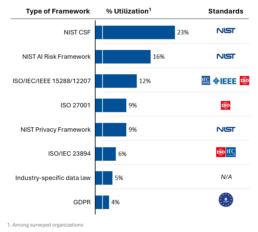
The NIST Cybersecurity Framework (CSF) 2.0, released in February 2024, reinforces the importance of robust governance and data-security practices, highlighting functions like “govern” and “identify” as foundational to managing emerging technologies, including AI. To align with this guidance, organizations should adopt privacy-by-design principles, embed explainable AI techniques in their development and deployment workflows, and formalize cross-functional governance, all while ensuring that model development, deployment, and monitoring involve both technical experts and business stakeholders. A strong governance structure helps to ensure regulatory compliance and ethical alignment and builds the foundation of trust required for broader AI adoption in security operations. Adopting frameworks like NIST CSF enables organizations to formalize their governance structures, reduce risk, and create a resilient environment in which AI can deliver value without introducing new vulnerabilities. Exhibit 5 outlines other governance frameworks that organizations frequently use when implementing AI.
Exhibit 5. % of Surveyed Organizations Utilizing Risk Frameworks
In Closing
Traditional cybersecurity and resiliency strategies are increasingly outpaced by the scale, speed, and sophistication of today’s threat landscape. Fragmented defenses, expanding attack surfaces, and the relentless evolution of adversarial tactics have exposed the limitations of manual, reactive strategies. In this context, AI has emerged as a transformative force by empowering organizations to move beyond isolated incident response and toward a unified, proactive approach to cyber resilience. AI-driven solutions now enable security teams to detect threats quickly, automate the triage and containment of incidents, and uncover root causes with speed and accuracy. Automated workflows and intelligent playbooks reduce mean time to resolution, while advanced analytics and feedback loops ensure that every incident strengthens organizational defenses for the future. This shift accelerates response time, alleviates analysts’ workload, improves accuracy, and empowers teams to focus on strategic tasks rather than repetitive firefighting. Looking ahead, the organizations that fully integrate AI across their incident management lifecycle will be best positioned to adapt to evolving threats, optimize resources, and build lasting resilience. As the threat landscape continues to evolve, AI-powered cyber resilience will become not just a competitive advantage but a foundational necessity for safeguarding digital trust.
- Cybersecurity Dive, 2025
- Checkpoint, 2025
- Coalition, 2024
- Hipaa Journal, 2025
- Sangfor Technologies, 2025
- Crowdstrike, 2025
- Security Week, 2024
- Security Week, 2024
- Cybersecurity Dive, 2025
- SmartDev, 2025
- Slashnext, 2025
- Crowdstrike, 2025
- KnowBefore, 2025
- Microsoft Security, 2025
- Cybercrime, 2025
- Axur, 2025
- Axur, 2025
- New Relic, 2025
- Ponemon Institute, 2024
- Ponemon Institute, 2024
- Rezolve. AI, 2025
- Security Vulnerabilities, 2025
- Indusface, 2024
- Indusface, 2024
- Algomax, 2025
- IBM, 2024
- Darktrace, 2023
- All about AI, 2025
- All about AI, 2025
- All about AI, 2025
- All about AI, 2025