

The Big Transformation
The Market Reset
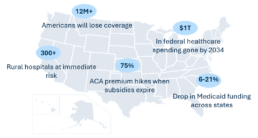
The One Big Beautiful Bill (OBBB) represents the most significant healthcare policy disruption since the ACA, fundamentally reshaping the industry landscape (refer Exhibit 1). Half of today’s healthcare organizations are predicted to not survive in their current form as the legislation eliminates traditional funding and regulatory structures that have sustained the sector for decades (1). This isn’t just a compliance challenge requiring operational adjustments, it’s the largest market consolidation opportunity in healthcare history.
Exhibit 1.Highlights of the Beautiful Bill (2)
Window of Opportunity
While most healthcare executives view OBBB as a threat to be managed defensively, the smartest ones recognize it as the ultimate reset button that levels the playing field. The magnitude of disruption means that established market positions, legacy advantages, and historical performance become less relevant than an organization’s ability to adapt quickly and capitalize on the chaos to follow.
The market has already started separating winners from losers based on transformation readiness, strategic agility, and capital positioning. The organizations that recognize this moment as their competitive window, will write the next chapter of healthcare
Capital Flight and Market Consolidation
OBBB is the largest structural change in U.S. healthcare economics in decades. By 2028, the winners stands to gain two to three times their current market share, along with the $50B fund intended to support rural health initiatives, including those focused on workforce development, system optimization and expansion of service delivery options through technological solutions, such as telemedicine (3).
The strongest players are already securing these positions: acquiring distressed providers, expanding profitable service lines, and locking in alliances that will be difficult to displace.
What Sets Leaders Apart
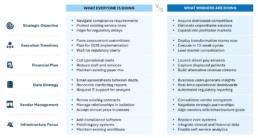
While most organizations are still interpreting OBBB and planning basic compliance responses, the fastest movers are already making bold decisions: accelerating M&A, divesting underperforming assets, re-negotiating vendor contracts, and re-platforming their data infrastructure. This moment will define who pulls ahead and who gets left behind—not by circumstance, but by execution.
Exhibit 2. Winners vs Losers
The Compounding Effect
Decision Acceleration Gap
The difference between winners and losers isn’t just about current performance, it’s about decision-making velocity that compounds over time.
Organizations with unified data and technology foundations complete strategic initiatives 40-60% faster than competitors relying on manual analysis and fragmented systems. Leadership teams need insights about costs, people, and operations, but that information is scattered across departments, requiring significant time for manual coordination while time-sensitive market opportunities worth millions annually slip away.
Infrastructure Divide Widens
Most healthcare organizations lack the technical foundation to execute transformation at speed. This infrastructure gap becomes exponentially larger.
Legacy systems cannot support real-time decision-making. While winners deploy enterprise architecture and data strategy, losers remain trapped in 5-6 layer systems requiring manual intervention at every decision point. Departments are already stretched managing current operations and cannot simultaneously build new capabilities.
Beyond Operational Band-Aids
Healthcare leaders are deploying every operational excellence tool in their arsenal: reducing inpatient length of stay, expanding outpatient access points, investing in AI and automation, tightening hiring and spend controls. These measures are necessary and smart, but they’re also what every competitor is doing.
The hard truth is that incremental improvements may not be sufficient for revenue disruption this deep. Organizations need to consider systemic transformation that creates sustainable advantages beyond operational optimization. Winners aren’t just doing the same things better; they’re doing fundamentally different things that create competitive moats their rivals cannot quickly replicate.
Service Line Reality Check
Low-margin services that depend on volume economics may require divestiture when patient volumes drop significantly. Rural outreach programs and community health initiatives that rely heavily on federal subsidies will face immediate viability challenges. Specialty services with high administrative overhead relative to patient volume may need consolidation or elimination.
Organizations clinging to unprofitable service lines will drain resources needed for competitive positioning. The difference between managing decline and funding growth comes down to making these difficult decisions quickly and decisively.
Revisiting Agility
Our Healthcare Agility Framework, discussed in the The Agility Prescription4 whitepaper directly addresses OBBB’s challenges: access, affordability, and innovation. But unlike operational excellence programs that reduce costs incrementally, this framework creates sustainable competitive advantages that compound over time.
Complete Visibility
Organizations need insights across the enterprise in hours, not weeks, to capitalize on market disruption and regulatory changes. Leadership teams need intelligence on costs, people, and operations, but that information is scattered across departments, requiring significant time for manual processing. Meanwhile, OBBB demands rapid responses to membership volatility from bi-annual redeterminations and coverage transitions.
Solution: Centralized data strategy connecting clinical, financial, and operational systems into single source of truth. Implement self analytics pipelines and real-time data connections enabling immediate strategic decisions.
Benefit: This speed advantage compounds during every market disruption. Enables leadership to capture market opportunities while competitors gather basic data and when the next major healthcare regulation arrives, you’ll adapt in weeks.
Exhibit 3. Pillars of Achieving Agility
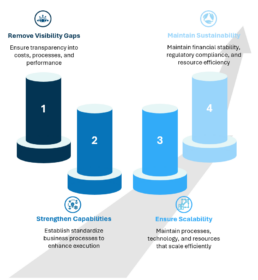
Strengthen Capabilities
Technology investments are often disconnected from business workflows, leaving transformations reliant on manual coordination and inconsistent reporting. While many organizations have mapped business capabilities and invested in data platforms, teams still fall back on Excel and ad-hoc analyses because business needs don’t drive the data roadmap.
Solution: Define capability-driven architecture, linking strategic objectives to operational execution. Deploy integrated workflow platforms to enable unified operations across departments.
Benefit: Transform operational data into business ready analytics that automatically identify areas needing M&A, efficiency opportunities, and growth markets while eliminating manual processes costing millions annually. Unified data, providing the same source of truth for Strategy, Operations, and Finance.
Ensure Scalability
OBBB creates volatility in membership, requiring systems that adapt dynamically to changing demands without excessive overhead or infrastructure investment.
Solution: Set up mechanisms to monitor how much is being used and what’s needed. Adjust resources based on actual usage. Use smart forecasting to plan staffing and manage resources more efficiently.
Benefit: Use live data to understand how resources are being used and run “what-if” scenarios to plan ahead. This helps proactive decisions instead of reactive like competitors who wait for quarterly results.
Maintain Sustainability
Organizations need clear governance systems to regularly review their services and spot areas that aren’t performing well, before they waste resources. The challenge isn’t just making changes, but ensuring those changes continue to deliver value as regulations evolve and market conditions shift.
Solution: Give business teams easy-to-use analytics tools and foster a culture of ongoing improvement. Build flexible vendor partnerships to avoid being locked into rigid contracts.
Benefit: These capabilities lead to smarter contracts, better spend visibility, and more agile resource allocation. Over time, they become compounding advantages, ensuring transformation efforts continue to deliver returns long after OBBB implementation, while competitors face mounting technical debt and operational drag.
From Framework To Readiness
Kepler Cannon’s Agility Framework provides a strategic foundation for transformation. But foundational design is only half the battle. Are you actually ready to execute?
Many organizations mistake compliance readiness—aligning policies, timelines, and budgets, for agility. But OBBB isn’t a policy problem. It’s a system-wide market reshuffle that demands dynamic, cross-functional preparedness. Agility isn’t just about structure. It’s about response speed under pressure.
The Agility Readiness Assessment bridges this gap by translating theoretical agility into a practical, diagnostic tool. It helps leadership identify hidden execution barriers, those that may compound risk, delay transformation, or paralyze response when disruption accelerate.
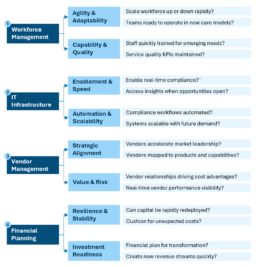
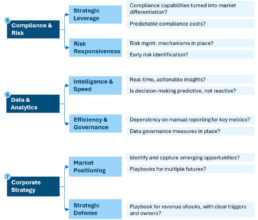
Readiness spans Workforce Management, IT Infrastructure, Vendor Management, Financial Planning, Compliance & Risk, Data & Analytics, and Corporate Strategy. Each of these seven domains contains interdependencies that either compound your agility or expose fatal vulnerabilities.
High scores in isolated areas mean nothing if gaps in others prevent rapid execution. For example, exceptional financial planning becomes irrelevant if your technology infrastructure requires months to pivot, or if your workforce lacks the agility to scale with market opportunities.
Exhibit 4. Readiness Assessment (1/2)
Accelerate To Action
Every capability gap revealed by your assessment must become a launchpad for targeted, rapid, and repeatable action. Sustaining momentum requires a system that connects priorities to execution.
To operationalize agility at scale, we recommend a structured activation approach rooted in three interconnected streams:
1. Domain Driven Operating Model: Design a user-centered operating model where each critical domain (e.g., Workforce, Compliance, Data etc.) feeds into defined decision points, escalation triggers, and governance rhythms, ensuring every part of the organization is calibrated to respond with speed and alignment
2. Cross-Functional “Impact Pods”: Establish cross-disciplinary teams, “impact pods”, tasked with unlocking the highest priority capabilities, operating in 12–16-week cycles, accelerating outcomes and enabling fast course corrections
3. Technology Fused Execution: Invest in technology, processes, and people (e.g., analytics, automation, reporting tools) that directly support user needs and fuel measurable change in decision making
When organizational architecture is shaped around real-world user, readiness becomes an engine of competitive advantage. Execution gets faster, coordination improves, and transformation moves from episodic projects to continuous capability building.
Exhibit 5. Readiness Assessment (2/2)
In Closing...
The so‑called One Big Beautiful Bill is more than another tweak to policy. It amounts to a structural reset of America’s healthcare market. By overturning old assumptions, unsettling revenue streams and inviting fresh models of care and reimbursement, it forces every health system onto volatile ground. All will face the same disruption; the distinction between leaders and laggards will be decided by how quickly, and how deftly, they match capabilities to new realities.
Readiness, in this context, is not a matter of dutiful compliance. It is the ability to act with speed, precision and conviction before the window closes. The right partners can amplify such efforts, by spotting businesses ripe for divestment, sequencing transformation sprints, and delivering results measured in months rather than years. More importantly, they leave behind lasting muscle: integrated data, nimbler governance, and adaptable service models that confer enduring advantage.
Healthcare brims with talk of transformation, yet the hard graft of execution too often lags. Choosing a partner versed in both bureaucratic thickets and operational urgency may separate leaders from mere survivors. The opportunity, though dressed as “generational,” will favor those who act swiftly.
- Local Hospital Closing Soon?, Kiplinger; Hospital closures, Becker Hospital Review
- 2025 Federal Budget, KFF; Spotlight on budget, AMA
- The One Big Beautiful Bill, The White House
- The Agility Prescription, Kepler Cannon