

The Role of Clinical Communications
In healthcare, communication is the connective tissue of patient care. From diagnosis to discharge, nearly every clinical action is informed by, or dependent on, a chain of timely, accurate, and often high-stakes information exchange. This includes synchronous methods, such as in-person handoffs, real-time team huddles, and phone consultations, as well as asynchronous tools, including clinical notes, secure messaging apps, and EHR documentation.
The breadth of this interaction makes clinical communication a critical determinant of care quality, patient safety, and operational efficiency. It directly influences care coordination, diagnostic accuracy, treatment planning, discharge decisions, and patient engagement.
THE PROBLEM
Despite its importance, clinical communication remains fragmented and highly manual. Dictation tools were built for physicians, and translation services for patients with limited English proficiency (LEP). Each challenge was tackled in isolation, leading to a patchwork of point solutions that rarely spoke to each other.
This fragmentation comes at a cost. Today, 86% (1) of clinicians switch between multiple communication tools during a single shift, with 54% saying it disrupts their workflow frequently. From the patient side, 32% (2) of individuals cite poor communication as the reason they switch providers, far more than concerns around privacy or costs.
The financial toll is equally significant. Inefficient communication has been linked to increased medical errors, extended hospital stays, and care delays, all of which compound cost pressures. A frequently cited study from 2010 estimated that communication failures cost the U.S. healthcare system over $12 billion annually. While recent system-wide estimates are scarce, the underlying drivers: fragmentation, redundancy, and inefficiency have only intensified, so today’s financial burden is likely even higher.
At the core of these challenges lies a shared goal: enabling accurate, context-aware, understanding and generation of clinical language, whether for documentation, translation, or patient communication. This is where recent advances in AI are beginning to delight.
THE RISE OF UNIFIED PLATFORMS
AI is collapsing these silos into unified platforms that serve the full care team. Ambient scribe tools like Microsoft’s DAX Copilot are reducing documentation time by ~20% and cutting after-hours by up to 30% (3). Gen-AI pilots at Mayo Clinic have reported AI’s ability to provide accurate and reliable documentation. Major vendors are expanding from single-use tools to platforms that integrate scribing, translation, patient summaries, and compliance support across settings.
The inflexion point is clear. Foundational AI, driven by LLMs, medical speech recognition, and multimodal interfaces, is beginning to unify fragmented clinical communication into connected, intelligent systems.
EVOLUTION OF AI IN CLINICAL COMMUNICATION
Phase 1: Manual and Rule Based Processes: Initially, healthcare providers used Dictaphones to record patient notes, which were then transcribed by typists. This method, while revolutionary at the time, was labor-intensive and prone to errors.
Phase 2: Digital Revolution: Computers, digital recording devices and word processing software replaced Dictaphones, allowing for clearer, more accurate recordings and faster transcription. Templates and macros reduced repetition and errors, laying the groundwork for automation.
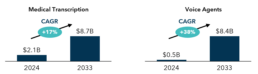
Phase 3: Modern AI Applications: Today, AI-driven communication tools use advanced speech recognition and NLP to convert spoken language into structured clinical notes in real time. Integrated with EHRs, these tools automate transcription and documentation, reducing manual data entry and accelerating workflows. With adoption rapidly increasing, the global market for AI-powered medical communication is projected to reach several billion dollars in the coming years. (see Exhibit 1)
Exhibit 1. Market Size: AI Medical Transcription (4) and Voice Agents (5)
Use-Cases and The AI Revolution
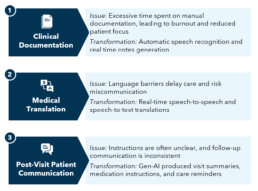
AI’s impact on clinical communication is most clearly seen across specific, high-friction use cases. While these challenges have long been addressed through disconnected tools and manual workflows, AI is now enabling real-time, context-aware, and patient-centric communication across the care continuum. (see Exhibit 2)
Exhibit 2. AI Communication Use-Cases
1. CLINICAL DOCUMENTATION
Recording of patient encounters, including symptoms, diagnoses, care plans, and follow-up actions, are foundational to care delivery, reimbursement, quality reporting, and legal compliance.
a. Stakeholders: Clinicians, providers, compliance teams, and health system administrators
b. Legacy Solutions: Dictation tools, manual transcription, and static EHR templates, all often prone to errors, lacking medical nuance, and requiring extensive manual editing.
c. AI Transformation: Advanced automatic speech recognition systems fine-tuned with medical lexicons and LLMs. Ambient AI scribes actively listen to clinician-patient conversations and generate notes, medical orders, and summaries in real time.
d. Emerging Capabilities: Voice-activated order entry, real-time clinical prompts, and self-updating EHR notes.
2. MEDICAL TRANSLATION
This helps bridge language gaps in clinical encounters, ensuring patients who do not speak the clinician’s language can understand their diagnosis, treatment plan and other instructions.
a. Stakeholders: LEP patients, interpreters (both in-person and virtual), and care teams.
b. Legacy Solutions: Traditional methods include interpreter services, on-site translators, adding logistical complexity, delays, and cost.
c. AI Transformation: AI now supports real-time speech-to-speech and speech-to-text translation directly during consultations. Cognitive translation engines are context-aware and preserve clinical nuance across languages.
d. Emerging Capabilities: Deployment of ambient multilingual note generation and instantaneous translation of discharge instructions via SMS or patient portal.
3. POST-VISIT PATIENT COMMUNICATION
This refers to all follow-up interactions that occur after a patient leaves the clinical setting, including visit summaries, medication guidance, appointment reminders, and self-care instructions
a. Stakeholders: Patients and caregivers, care coordinators, case managers, and providers.
b. Legacy Solutions: Manually dictated or typed summaries, call-center follow-ups, and generic printed discharge packets, all of which may arrive late, lack personalization, or use inaccessible language.
c. AI Transformation: Gen-AI automatically produces plain-language visit summaries, medication instructions, and care reminders that can be delivered via portal, SMS, or email, often in a patient’s preferred language.
d. Emerging Capabilities: Personalized education materials matched to individual literacy levels and integration of communication with remote-monitoring tools to deliver dynamic, context-aware guidance based on real-time health data.
Market Landscape
Past Successes
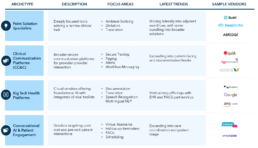
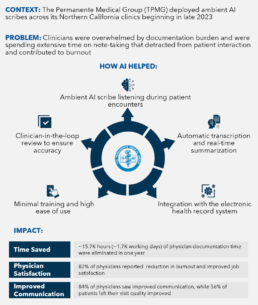
Healthcare organizations globally are embracing AI assistants, speech recognition, and language‑translation tools to reduce clinician burden, improve documentation accuracy, and boost patient satisfaction. The efficiency and care quality improvements in hospitals and dental clinics is measurable. (see Exhibit 3)
Community Health Network (6), a 200-site system in Indiana, has deployed the Nuance Dragon Medical platform and DAX Copilot to automatically draft clinical notes during in-person and telehealth visits. Rolled out to 400 clinicians, the AI has reduced documentation burden, improved efficiency, expanded access to patient data, lessened burnout, and strengthened clinician–patient interactions.
Rogers Behavioral Health (7) has adopted Limbic Access, an AI chatbot that conducts initial mental health screenings with 93% accuracy, replacing multiple questionnaires and cutting provider assessment time to under 30 minutes. With 24/7 safety monitoring to flag crises, connect patients to resources, and alert care teams, it has streamlined intake, enhanced risk management, eased clinician workload, and improved access for diverse patient populations.
Suki (7), an ambient AI assistant and scribe solution, recently raised $70 million in Series D funding. The platform now serves over 300 health systems, including phased rollout at MedStar Health and integration with EHRs. Client systems report up to 72% faster note completion, a 70%+ clinician adoption rate, improved documentation quality, and reduced burnout.
Exhibit 3. Kaiser’s Permanente’s ambient AI scribe experience (6)
Key Considerations and Readiness Assessment

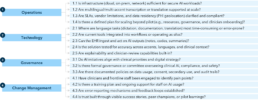
In addition, AI-driven clinical communication must meet strict regulatory and risk standards, including HIPAA compliance, possible FDA oversight for certain functions, and adherence to state privacy laws like CCPA/CPRA. Tools should be tested for bias, have clear liability protections, and maintain audit trails of AI outputs and clinician edits to ensure accountability and equitable care. These requirements underscore the importance of readiness, as organizations must have the policies, infrastructure, and oversight mechanisms in place before deployment. The readiness assessment framework (see Exhibit 4) helps gauge whether these foundational elements are established to support safe and effective AI use.
Exhibit 4. Readiness Assessment Framework
The Path Forward
In U.S. healthcare, AI-driven clinical communication tools promise major gains in efficiency, accuracy, and patient experience. However, many organizations get stuck in 12–18-month rollouts.
The following proven strategies can help health systems implement AI tools more quickly and effectively.
1. Start Narrow, Then Expand: Rather than attempting a full-suite rollout, successful organizations choose one or two high-value use cases (e.g., ambient scribing in urgent care or multilingual discharge instructions) that demonstrate impact within weeks. These early wins provide both proof of concept and the confidence to scale across specialties and facilities.
2. Use Vendors with Pre-Built EHR Integrations: Epic, Cerner, and MEDITECH certified integrations dramatically shorten implementation timelines. Vendors that offer ready-made templates, clinical lexicons, and governance playbooks reduce the need for in-house customization. Negotiating vendor-led configuration as part of the contract keeps the IT teams free for other priorities.
3. Leverage Cloud-Based, HIPAA-Compliant Platforms: Cloud services like AWS, Azure for Healthcare, or Google Cloud Healthcare API eliminate the cost and time of local infrastructure buildout. They make it easier to extend pilots to multiple facilities while maintaining data security and compliance from day one.
4. Piggyback on Existing Change-Management Channels: Rolling AI adoption into existing EHR or compliance training programs avoids creating new layers of bureaucracy. Leveraging established governance committees keeps oversight streamlined and familiar to stakeholders.
5. Demand a Rapid Pilot Model from Vendors: High-performing health systems insist on 4–6-week pilot packages where vendors lead configuration, training, and feedback cycles. Defining success metrics (e.g., reduced note completion time) before the pilot starts ensures alignment and accountability.
6. Reuse Policy & Compliance Frameworks: Instead of drafting new rules from scratch, adapt existing HIPAA, PHI handling, and audit trail policies for AI tools. Updating Business Associate Agreements (BAAs) rather than renegotiating them accelerates legal clearance.
7. Partner with Consulting Teams for “Fast-Track AI”: Specialist consulting firms bring vendor shortlists, pre-vetted ROI models, and proven integration playbooks that cut trial-and-error out of the process. Clinician-led change management from these teams also helps drive adoption without waiting for internal bandwidth to free up.
Conclusion
AI is not replacing communication in healthcare, it’s enhancing it. From ambient scribes to real-time translation, emerging tools are helping clinicians reclaim their time, reduce documentation burdens, and re-center the patient-provider relationship. But the promise of AI in language isn’t automatic, it demands intentional design, rigorous validation, and a strong commitment to equity.
Healthcare organizations must take a proactive stance: understanding where communication bottlenecks lie, identifying high-impact use cases, and ensuring that AI solutions are accurate, inclusive, and secure. Piloting these technologies in a controlled, clinician-led environment allows for feedback-driven improvement and trust-building.
As the landscape matures, now is the time to explore pilots, evaluate vendors with an eye toward safety and fairness, and lay down the integration pathways that will future-proof systems. Done right, AI in clinical communication is not just a digital upgrade, it’s a human one.
- Tiger Connect (2024)
- Beckers Hospital Review (2025)
- JAMA Network (2025)
- Growth Market Reports (2025)
- Nova1Advisor (2025)
- Company Websites
- Fierce Healthcare (2024)