

Reimagining Service Management with AI
In January 2025, Microsoft unveiled an artificial intelligence (AI)-driven transformation strategy to revolutionize its service management processes. Led by Microsoft Digital, its internal IT function, the initiative harnesses insights from more than 200,000 incidents, 100,000 IoT devices, and 500,000 SharePoint sites to build intelligent capabilities that substantially enhance the organization’s operational efficiency. Acting as its own first adopter, or “Customer Zero,” Microsoft Digital is leveraging its own service data to generate actionable insights (e.g., smart routing). These insights are powered by AI-enabled features such as predictive maintenance, advanced detection of anomalies, and intelligent self-service (1). As one of the world’s most influential technology companies, Microsoft’s integration of AI into its service management has set a high standard that many organizations are eager to follow. In fact, approximately 88 percent of midsize to large enterprises have already begun incorporating AI technologies into their service management processes; of these, ~40 percent have reported a reduced workload of service management personnel (Exhibit 1) (2).
A future in service management that does not include AI is all but unimaginable. Organizations that use AI as part of their service management already report a 40-60 percent reduction in the mean time to resolution and up to an 80 percent decrease in Level 1 ticket volume (3). Organizations that recognize and embrace AI’s power can streamline service management operations and deliver faster, more customer-centric support, gaining a competitive edge in the process.
Exhibit 1. AI Usage in Service Management
The Cloud-Hybrid Challenge
Organizations are grappling with growing service management challenges as they shift to cloud services and hybrid infrastructure. Such transitions usually increase operational complexity, requiring teams to manage dispersed environments, enforce consistent security policies across a hybrid environment, and respond to a broader volume and a larger variety of service requests. Supporting both cloud-based and on-premises systems simultaneously also necessitates specialized skills that are increasingly scarce. Unsurprisingly, 80 percent of organizations report delays in issue remediation and infrastructure blind spots stemming from these complexities (4). Although some responsibilities like asset maintenance or patching may shift to cloud providers, a substantial portion of IT operations still takes place in traditional data centers — often managed by siloed internal teams — adding further strain on service management functions already under pressure.
This surge in operational complexity has directly contributed to the rise in service requests that 56 percent of IT professionals reported in 2024 (5). As service request volumes rise and IT environments grow increasingly complex, manual and traditional service management approaches are no longer sufficient. To meet modern demands, AI-driven automation and decision support are becoming indispensable — enabling organizations to unlock greater efficiency, reduce costs, and enhance customer satisfaction.
AI at Work in Service Management
AI is reshaping service management by enabling smarter, faster, and more efficient support operations. Leading organizations are already leveraging AI-powered capabilities such as predictive maintenance, self-service, and smart ticket routing to accelerate resolution times, boost technician productivity, and reduce ticket volumes.
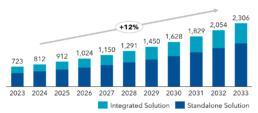
For example, in 2024, the global predictive maintenance market alone was valued at over $812 million (Exhibit 2) (6). Energy giant Shell, in conjunction with C3 AI and Microsoft, deployed AI-driven predictive maintenance for more than 10,000 pieces of equipment in 2023. Generating more than 15 million daily predictions across 3 million data streams, the predictive maintenance capability is credited with a 35 percent reduction in unplanned downtime, a 20 percent decrease in maintenance costs, and nearly a 40 percent reduction in incidents related to equipment failure (7).
The case for growing AI-enabled capabilities in service management operations is driven largely by the rapid expansion of data and infra-as-code environments. The global volume of data created, captured, copied, and consumed is projected to exceed 180 zettabytes by 2025; thus, organizations need tools that can turn raw data into actionable insights (8). AI-powered analytics process vast datasets in real time to uncover hidden patterns, predict trends, and recommend strategies for making smarter, faster decisions and optimizing workflow operations.
Exhibit 2. AI-enabled Predictive Maintenance Market
2023 – 2033 (USD, millions)
With the rapid rise of infrastructure-as-code and cloud-native environments, innovation cycles are moving faster than ever. To balance the need for agility with control, organizations are turning to AI to automate development and operational tasks, proactively detect anomalies, and prioritize work efficiently. Given AI’s transformative role in this fast-paced innovation landscape, it’s essential to understand how it integrates throughout the entire service management lifecycle. From incident detection to triage to resolution, AI can enhance every phase to drive substantial improvements. The service management lifecycle alone includes more than 30 AI use cases, with four key examples that span all phases detailed in the next section.
Exhibit 3. (Select) GenAI Opportunities Across the Service Management Lifecycle

From Request to Resolution
AI is poised to reshape the service management lifecycle by driving efficiency across every phase. As organizations grapple with increasing complexity across hybrid environments, AI is enabling faster decision-making and resolution of requests, often resolving issues early in the support process and even preventing ticket submissions.
To demonstrate the breadth and impact of AI across the service management lifecycle, the following section highlights four key use cases: predictive maintenance, self-service enablement, complexity estimation for smart ticket routing, and auto-resolution. Collectively, these examples demonstrate how AI can proactively detect and prevent issues, streamline operations, and accelerate resolution times to deliver measurable gains in efficiency, productivity, and operational resilience at every stage.
1. READINESS & PREVENTION
Managing service requests and their associated assets proactively requires systems that can anticipate demand, validate configurations, and ensure that fulfillment pathways are optimized before a need for servicing occurs. These systems are best demonstrated in the context of asset maintenance, where the healthcare industry alone spends an estimated $93 billion annually on equipment costs (10). Existing maintenance management solutions (e.g., Computerized Maintenance Management Systems, or CMMS) still rely on static rules and reactive solutions that delay detection and hinder proactive resource planning.
Companies that enable AI-driven predictive maintenance by ingesting vast amounts of operational, historical, and contextual data develop predictive, data-driven maintenance strategies that can forecast failures before they happen. With predictive maintenance, organizations can minimize unplanned downtime and improve capacity planning by gaining clear insight into when and where technicians are needed most, thus increasing efficient scheduling and use of equipment.
USE CASE: PREDICTIVE MAINTENANCE (Exhibit 3–1.2)
The current asset-maintenance process contains opportunities for AI to have an impact at each stage: asset onboarding, baseline configuration, health monitoring, patching and maintenance, and end-of-life planning and decommissioning.
A. Asset Onboarding: An asset is acquired and registered in CMDB, along with metadata that includes details about its warranty, vendor, and location. AI automation can streamline onboarding through asset auto-discovery and data validation.
B. Baseline Configuration: The asset receives standard configuration and undergoes policy checks for security, regulatory, and operational readiness (e.g., internal benchmarks). AI can detect misconfigurations by comparing the new asset’s settings to baseline norms across additional internal assets.
C. Health Monitoring: Once deployed, the asset is monitored using tools (e.g., IoT sensors) that capture performance metrics, environmental conditions, and usage trends. AI models can ingest telemetry data (e.g., CPU load, temperature, memory usage, fan speeds) to establish baselines and detect early degradation. ML models can also adapt to asset-specific behaviors over time, thus reducing false positives from static alerting systems.
D. Patching & Maintenance: The asset undergoes maintenance activities like preventive methods (e.g., scheduled patching, hardware checks) and real-time interventions (e.g., threshold breaches). AI models can predict which assets are likely to fail and when, prompting proactive creation of tickets or dispatch of technicians. AI can then recommend maintenance windows based on predicted impact of identified vulnerabilities, usage patterns, and availability of resources.
E. End-of-life Planning: Assets are retired based on declining performance, expiration of support (e.g., warranties, vendor contracts), or results from cost-benefit analysis. Proper offboarding and compliance procedures are followed to ensure secure and efficient decommissioning. AI models assess operational metrics (e.g., system downtime, maintenance frequency, support costs) and cost trends to recommend the optimal timing for asset retirement. These models can also simulate “what-if” scenarios to evaluate the impact of various replacement timelines, helping to minimize risk and maximize return on investment.
AI-driven predictive maintenance’s impact can be transformative. Using predictive maintenance’s smart, targeted interventions, organizations can slash unplanned downtime by up to 50 percent and reduce maintenance costs by as much as 40 percent (11). Facility downtime can shrink by 5–15 percent and labor productivity can increase by 5–20 percent, unlocking new levels of operational efficiency (12). All in all, AI-enabled predictive maintenance empowers organizations to optimize capacity planning by ensuring technicians are deployed when and where they are needed, thus minimizing waste, reducing downtime, and driving significant cost savings.
2. TRIAGE & CONTAINMENT
As organizations mature their service management capabilities, many look beyond prevention to more intelligent ways to handle the growing number of service requests. Before tickets are created or routed to support teams lies an opportunity to triage and contain issues at the source, whether through self-service portals, virtual agents, or AI-generated articles. Such articles are often created manually and inconsistently, resulting in gaps and outdated information that limit their usefulness. When relevant self-help articles are available, users frequently bypass them and submit tickets, increasing the strain on support teams. Service desk agents occasionally tag or suggest articles after ticket resolution, but this practice is often inconsistent with insufficient follow-through. Moreover, there is often a lack of established feedback loops that connects resolved tickets back to improvements in articles’ content and the self-service experience, preventing continuous enhancement of support capabilities.
AI can help bridge these gaps by automatically creating knowledge articles from resolved tickets and detecting recurring patterns. By continually refining knowledge content based on real support interactions, AI greatly enhances the quality and relevance of resources that empower users to resolve issues on their own. This, in turn, can drive higher adoption of self-service options and can lead to a reduction in support tickets, as detailed in the next use case.
USE CASE: AI-ENABLED SELF-SERVICEABILITY
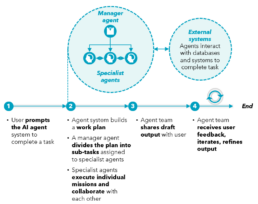
The self-service request resolution process consists of four key phases (see Exhibit #4) to intake requests, interpret user intent, surface relevant knowledge, and enable issue resolution prior to ticket creation.
A. Request Intake: Users initiate support by submitting a request or searching for help via a portal, chatbot, or email, often defaulting to ticket creation. The AI orchestration engine captures this input in natural language and prepares for automated analysis.
B. Intent Detection: The system interprets the users’ input to understand the underlying intent, classifies the request type, and extracts key details. This step enables structured handling of the issue and determines the most appropriate next action.
C. Knowledge Retrieval: Based on the detected intent, the system searches for relevant articles, documentation, or guidance within the knowledge base, and surfaces the most relevant content to help address the user’s issue efficiently.
D. Request Resolution: The user reviews the recommended content and either resolves the issue independently or triggers an escalation to support. Resolution outcomes help inform future improvements to content and automated knowledge retrieval.
Optimizing AI-driven self-service promises to enhance scalability and reduce ticket volume. With increased self-service through AI-enabled articles, a service management team can handle up to 10 times more requests (13). AI-powered self-service options also reduce the number of IT support tickets by automating common resolutions and empowering users to solve issues independently. Reduced strain on support teams, faster resolution times, and a continuously improving knowledge ecosystem that keeps pace with users’ evolving needs result.
Exhibit 4. AI-enabled Knowledge Retrieval & Self-Service

3. INTELLIGENT DISPATCH
If a service request cannot be prevented through predictive maintenance or resolved via self-service, it must be assigned to a technician for further action. Managing the assignment and resolution of IT service requests effectively requires systems that can assess a ticket’s complexity, technicians’ skills, and real-time availability dynamically to ensure each issue is routed efficiently to the most qualified resource. Currently, assignments to L1, L2, or L3 support tiers are often guided by informal knowledge, rather than consistent criteria, which can lead to misrouted tickets and unnecessary escalations. Without a standardized approach to estimating the effort, skill requirements, and dependencies that are necessary to resolve an issue, dispatch decisions are largely reactive, driven by availability rather than the best fit. This issue contributes to inefficient handoffs and longer resolution cycles.
Intelligent dispatch leverages AI and automation to transform this process. By analyzing vast amounts of operational and contextual data, these systems optimize technician assignments, minimize idle time, and increase first-time resolution rates. As a result, organizations reduce operational costs, and they and their customers benefit from faster resolution times.
USE CASE: SMART ROUTING VIA COMPLEXITY ESTIMATOR
This section outlines the current ticket assignment and dispatch process of ticket creation, initial triage, assignment to a tier, selection of a technician, and estimation of the effort required, along with opportunities for AI to enhance efficiency and decision-making.
A. Ticket Creation: In the current state, users or agents who submit tickets often enter urgency and impact fields inconsistently. NLP can auto-extract key details from descriptions on a ticket and apply a standardized complexity score upon ticket creation.
B. Initial Triage: Rather than relying on manual review, the complexity score can enable automated triage based on historical patterns, estimated impact, and expected resolution time. For example, let’s assume a user submits a ticket: “Outlook crashes when opening shared calendars”. NLP can identify keywords such as “Outlook”, “crashing”, and “shared calendars” and assign a moderate complexity score based on historical patterns of similar issues.
C. Tiering Assignment: Assignment to a support tier (e.g.,, L1 vs L2) is typically based on tribal knowledge or guesswork. Trained AI models can determine the most appropriate support tier by analyzing the ticket’s language, scope, and inferred effort. In the prior example, the AI model may detect that similar issues have arose from a known configuration bug in recent Outlook versions, routing directly to Tier 2 support and bypassing Tier 1 which may lack necessary permissions to apply a fix.
D. Agent Selection: Intelligent dispatch engines powered by AI go beyond basic availability. Rather, they factor in technician skillsets, current workload, prior experience with similar issues, and performance history to assign the best fit agent. For the support ticket mentioned above, the AI system may identify a Tier 2 technician who recently resolved similar Outlook-related calendar issues with a low current workload. It may also predict a more accurate resolution time and flag a dependency on elevated access permissions, allowing the system to pre-verify access needs before assignment.
AI-driven tools that assist in categorizing the level of complexity and smart routing can save technicians 11–13 hours per week by reducing manual triage and misrouted tickets (14). Smart routing can also reduce how often tickets are transferred from one technician to another by up to 90 percent by ensuring requests are directed to the most appropriate agents without unnecessary delays or handoffs (15). As a result, first-time resolution rates can improve by 15–25 percent compared to traditional queue-based systems. Optimized scheduling, real-time resource allocation, and streamlined technician dispatch to avoid unnecessary travel time can reduce overall service costs by up to 30 percent (16) (17). Together, these improvements enable IT service teams to deliver faster and more accurate support while also maximizing efficient use of resources.
4. RESOLUTION ACCELERATION
Accelerating ticket resolution is a persistent challenge for IT service teams. Traditional processes are often laden with manual triage, multiple handoffs between different teams, and fragmented communication, slowing resolution and frustrating users. As ticket volumes and complexity grow, these delays only intensify. However, AI is reshaping this landscape by automating key steps, delivering smart insights, and streamlining workflows. With increased automatic resolution driven by AI, organizations can cut resolution times substantially and provide faster, more reliable support, thus turning a cumbersome process into a competitive advantage.
USE CASE: AUTO RESOLUTION
The following workflow outlines how AI enables end-to-end auto-resolution of service requests by interpreting user intent, applying decision logic, and executing automated actions without intervention.
A. Request Intake: A user initiates a service request through a portal, chatbot, email, or system trigger. AI components such as natural language understanding (NLU) process the input in real time, extracting keywords and routing the request for smart handling.
B. Intent Detection & Classification: AI models analyze the request to determine its underlying intent, leveraging trained classifiers and historical ticket patterns. The request is matched to a predefined, automatable category and enriched with structured metadata (e.g., urgency, affected system, user role).
C. Automation Triggering: Based on the classified intent and policy criteria, AI decision engines evaluate whether the request is eligible for auto-resolution. If eligible, the system triggers an orchestration workflow, RPA bot, or backend API to execute the required task — all without human intervention.
D. Confirmation & Continuous Learning: Once resolved, the system communicates the outcome to the user and closes the request. AI captures resolution data, monitors automation performance, and flags patterns (e.g., failure points, repeat requests) to refine automation logic and expand auto-resolution coverage over time.
By automating routine service requests through AI, organizations can significantly improve the speed of resolutions. With AI-powered automatic resolution, organization can see their mean time to resolution drop from days to a few minutes for common IT issues (e.g., password resets). In fact, AI-based automation can accelerate incident resolution by up to 50%, enabling IT teams to address a higher volume of tickets with fewer resources (18). This improved speed translates into operational efficiency, cost savings, and a more seamless user experience, ultimately enhancing the service management lifecycle.
Looking forward…
While AI has already started to transform service management, many organizations are still in the early stages of adoption, whether by testing isolated use cases or relying on vendor-specific tools that limit flexibility. As models and providers rapidly evolve, the challenge becomes scaling AI without getting locked into rigid architectures or long-term dependencies.
To future-proof AI adoption in service management, organizations should pursue a modular, model-agnostic architecture to enable flexibility across evolving tech stacks and provider ecosystems. Whether by leveraging commercial models, open-source alternatives, or proprietary in-house LLMs, this approach ensures plug-and-play compatibility and helps reduce the risk that is associated with long-term commitments. By enabling a “bring-your-own-model” (BYOM), enterprises can allow teams to transition between providers like Claude or internal LLMs based on performance, price, or data governance. With custom components like retrieval-augmented generation (RAG), vector databases, or private APIs, a modular system can be fine-tuned or augmented with help for specific business needs.
Architectural flexibility becomes particularly important when an organization operationalizes AI-enabled service management use cases, where it will typically face a choice between building solutions in-house or adopting off-the-shelf tools. In many cases, the most effective path is a hybrid approach that combines the scalability and speed of third-party solutions with the unique value of internal, proprietary service data to tailor in-house components for enterprise specific needs. By integrating this data into any AI model, organizations can achieve more accurate predictions and smarter automation that is finely tuned to their specific environment.
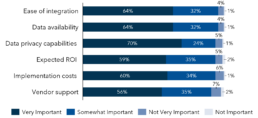
However, this journey is rarely straightforward. Many enterprises encounter significant challenges when they deploy AI in their service management environments, often because of limited AI expertise and use of legacy systems (Exhibit 5) (19). In addition, organizations must weigh the trade-offs between open-source and commercial AI solutions. Open-source models often offer more flexibility and control over data than commercial solutions do, so they are attractive for organizations that have strict compliance or customization needs. Commercial solutions provide enterprise-grade support, rapid deployment, and ongoing updates, but they may raise concerns about data privacy, compliance, and vendor lock-in.
Given these data-governance and compliance challenges, organizations in highly regulated industries (e.g., healthcare, financial services) are seeking clear standards on how to manage data privacy and risk when adopting AI. To address these concerns, the National Institute of Standards and Technology (NIST) published NIST-AI-600-1, Artificial Intelligence Risk Management Framework (AI RMF), in late 2024. The AI RMF provides organizations with structured guidance to help them design, develop, and deploy trustworthy AI systems that support lifecycle risk management and identifying and mitigating the risks that are associated with adopting AI. Coupled with a cross-functional effort that brings together stakeholders from IT strategy, security, compliance, and business operations, this framework ensures the development of AI-enabled features that are both trustworthy and aligned with broader enterprise goals.
Exhibit 5. Importance of factors in AI Adoption
In Closing
Traditional approaches to service management are insufficient in the face of today’s rapidly evolving IT environment. Fragmented systems, infrastructures’ growing complexity, and end users’ rising expectations have exposed the limitations of legacy models. In this landscape, AI offers a powerful opportunity to reimagine service management as not just a reactive support function but a proactive, intelligent, and user-centric capability.
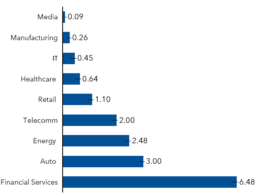
AI-enabled solutions can deliver measurable impact across the service lifecycle. Intelligent routing can reduce average resolution time by up to 35 percent, while AI-powered self-service can address commonly recurring service requests, deflecting tickets by as much as 53 percent (20). Predictive analytics can detect asset anomalies early helping to prevent costly downtime. This capability is increasingly valuable given the rising costs of unplanned downtime across industries — one hour of downtime costs over $600,000 in healthcare (Exhibit 6) (21).
However, capturing these gains requires more than just adopting new technologies; it demands an enterprise-wide shift to modular and model-agnostic architectures that support plug-and-play AI capabilities, strong data governance that ensures model integrity and privacy, and a robust change-management strategy that fosters adoption across IT, security, and business units.
Organizations that approach this transformation to AI strategically, with cross-functional alignment and a focus on scalability, will not only unlock immediate operational efficiencies but also build a resilient foundation for long-term innovation. The path forward is that of automation and AI that enable smart, fast, and human-centered service delivery at scale.
Exhibit 6. Cost of Unplanned Downtime (USD/hr., millions) (21)
- Microsoft Digital, 2025
- Atlassian, 2024
- Microsoft, 2025
- Broadcom, 2024
- Ivanti, 2024
- Market.US, 2024
- C3 AI, 2024
- Statista, 2024
- Informed estimates based on industry benchmarking
- Philips, 2025
- OxMaint, 2024
- IBM 2023
- Atera, 2025
- Atera, 2025
- NobelBiz, 2025
- Ailoitte, 2025
- Loginext, 2024
- EasyVista, 2025
- Atlassian, 2024
- Freshservice, 2024
- Ping, 2023