


From Hype to Hard Value
You’ve heard great things about AI. From writing polished emails to building entire applications, it seems there’s nothing that AI can’t do. We find ourselves easily using AI in our personal lives. Why is it the case, then, that AI is so tricky to implement in an organization?
Business leaders are feeling the pressure. Boards and investors demand AI transformation, LLMs get better every month, and 10 new AI tools have sprung up advertising for your use case. And yet, the AI-enabled acceleration just isn’t happening.
Some might think there’s too much corporate red tape. Or perhaps, there’s no tool that addresses their specific problem statement – it’s too complex. These can be valid points, but they are not valid reasons to put your problem statement on pause.
At Kepler Cannon, we’ve worked with the world’s biggest companies to drive tangible AI-enabled acceleration across entire business units. The differentiator lies in an approach which first assesses the problem statement, only afterwards bringing in the most suitable LLMs, tools, and technologies available. Through this methodology, we’ve built dynamic solutions that evolve with the firm’s changing policies and constraints, allowing problem statements to be solved and stay solved over time.
Exhibit 1. The Widening Gap in Adoption

The Paradox
Stanford’s 2026 AI Index found that 88% of organizations now use AI in at least one business function, but only 7% report it as fully deployed and integrated across the enterprise¹. Research from IDC and Lenovo confirms the same pattern at the project level – of every 33 proof-of-concepts launched, only four reach production². The gap isn’t in adoption. It’s in the path from pilot to production.Despite the abundance of AI tools in the marketplace, we’ve found that change and innovation comes not just from better tooling, but from an awareness of deployment considerations instead:Q1. Use case clarity: “What exactly are we solving, and how will we know it worked?” Most AI pitches lead with a capability, not a problem. The team can describe what the tool does, but they can’t articulate the business outcome that justifies it.Q2. Vendor-POC gap: “I’ve seen the demo. Show me it works on our data.” Vendor demos run on curated examples in their sandbox, but it’s the non-standard edge cases that are hardest to solve in a proof-of-concept (POC).
Q3. Security, compliance, and concentration risk: “Where does our data go, and what’s the regulator’s view?” Where data lives, how the model was trained, who has access, and whether the deployment satisfies your firm’s policy and regulatory regime are non-negotiable, not items to be sorted out post-pilot.
Q4. Operating model and ownership: “Who runs this post-pilot, after the project team rolls off?” Every AI tool needs an owner, i.e., someone accountable for model refreshes, integrations, performance monitoring, and the inevitable “this output looks wrong” investigations.
Q5. KPIs and definition of success: “What’s the baseline, the target, and the timeline?” Even when the use case is real, organizations frequently cannot define success precisely enough for the AI tool, or the team, to deliver against it.
Two failure modes show up across nearly every stalled program: vendors that demo cleanly but fail inside the client’s environment, and tools that age out faster than the procurement cycle that clears them. The next section maps the three deployment paths that respond to both.
Deployment Paths & Trade-offs
Both traps share the same root cause: the deployment path was committed to before the deployment requirements were understood. The fix isn’t a better vendor – it’s a better question.
Before you can decide what to deploy, you need a clear-eyed view of how AI can actually enter your organization – what model access you have, what data can move where, who owns the workflow post-pilot, and which governance gates the solution must clear. Only then can you choose a path that fits.
There are three paths to deployment, each with different trade-offs on speed, environment fit, and long-term adaptability.
- Bring in a fully-built third-party tool: The vendor route. A solution that arrives pre-developed for a specific use case. Configure and use it.
- Strength: fastest time-to-demo. The capability is real and ready in the vendor’s sandbox.
- Weakness: slowest time-to-deployment in regulated environments. Data residency, third-party risk, model approval, and integration with internal systems frequently consume more elapsed time than building in-house would.
- Hidden risk: vendors ship updates constantly – but each material upgrade typically triggers a fresh governance review. By the time today’s version clears, the next is already shipping.
Exhibit 2. Tooling Deployment Choices
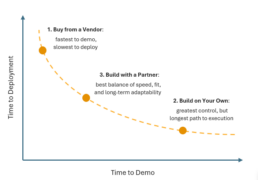
- Build on your own: Net-new solution built entirely inside your environment by your own team, combining approved model access with a thin, organization-specific solution layer on top. No third-party risk review, and no data leaving your infrastructure.
- Strength: fits your environment, your data, your governance, and your AI literacy. Not load-bearing on any single vendor.
- Weakness: requires an internal team with the bandwidth and cross-functional range to scope the use case, build the solution, and maintain it. Your team may not be up to speed on the latest available processes and tools, which limits them to what’s already approved.
- The honest ceiling: most business units don’t have that combination sitting idle. The technical capability may exist somewhere in the organization; what’s missing is the link between the people who know the technology, the people who know the workflow, and capacity.
- Build with a partner: Net-new solution shaped around your environment, your data, and your problem statement, but executed alongside a partner who has navigated this terrain before.
- Strength: fits your environment without re-introducing the governance bottleneck a third-party tool would have created. The solution is owned by your team, not the partner’s.
- Why the partner matters: the right partner builds with you, not for you. They codify your team’s expertise (e.g., the judgment calls, the edge cases, the unwritten rules) into the solution itself. This allows you to update it as per future requirements and keep it alive as the AI landscape moves, because the value is not in the vendor’s model.
- The key distinction from Option 2: a partner collapses the timeline. What can take an internal team a year, a seasoned partner can move from proof-of-concept to production in months.
Exhibit 3. AI Deployment Options
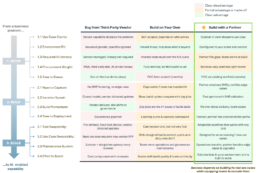
What to Expect from a Partner
Most organizations already have the ingredients for success: teams, vendors, platforms, and SMEs. What they lack is a business‑first build around a specific problem that turns those capabilities into real outcomes.
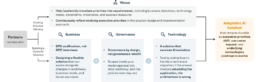
When looking for a partner, you should evaluate a) how they shape the vision, and b) how they codify the solution.
- Executive vision:Strong partners start from your business priorities and convert them into solution requirements, rather than arriving with a tool and searching for a use case.
- Codification and configurability: Partners work closely with front‑line experts to translate their judgment into clear rules, workflows, and configurations. They design the solution to handle real‑world edge cases from the start and to operate within your approved models, data‑residency constraints, and risk policies.The result is a durable solution that survives executive changes, use‑case expansion, and ongoing AI evolution.
The diagram below shows how the four dimensions come together in practice across the two broad focus areas.
Exhibit 4. What a Partner Brings to an AI Build
A Business-First Framework
Leading organizations can use this business‑first approach to streamline high-volume workflows ranging from procurement approvals and operations queues to contract pricing and billing reconciliation, among others. Kepler first designs the end‑to‑end business workflow with the client, then layers in AI agents to automate data capture, routing, and decisioning.
Working alongside the client organization’s domain experts, Kepler maps the process, codifies edge-case logic, and builds a deployable solution inside the client environment.
- In procurement, this can mean reviewing intake requests, extracting key terms from supporting documents, routing approvals to the right stakeholders, and flagging exceptions before they slow the process.
- In billing, this can mean identifying pricing and rate terms from contracts, matching them to internal billing logic, surfacing discrepancies for review, and returning structured outputs into approved downstream systems.
- More broadly, the same approach can be applied to any workflow where there is an opportunity to accelerate review, codify decisions, and embed AI into day‑to‑day execution.
Because these solutions are built with the people doing the work and deployed in the organization’s own environment, they
they embed institutional expertise and remain durable as models evolve. As new edge cases emerge, business users can adjust rules, add agents, and refine prompts without re-architecting the solution, so AI becomes part of the operating model rather than a one‑off experiment.
Exhibit 5. Business-First AI Deployment

In Closing…
One-third of organizations have already replaced at least one external tool with a custom-built generative AI solution3. Enterprises are now racing to encode workflows as quickly as possible. Yet many organizations are discovering that building a tool quickly is the easy part; building it sustainably is a far more complex challenge.4The most sustainable AI approaches are tool-agnostic and environment-aware. Firm policies can change, AI literacy differs across business units, and integration constraints often determine what is actually deployable. The right deployment accounts for those realities upfront, so the business process remains stable even as underlying models and tools evolve.How we can help:Environment assessment: understand your approved models, data infrastructure, integration constraints, and vendor landscapeUse-case definition: define the business problem, success metric, and operating owner before a tool is selectedPolicy-aligned POC: build within your existing stack and governance model from day oneIn-environment deployment: deliver production-ready solutions with replaceable underlying models and durable business logic
- Stanford Institute for Human-Centered AI (HAI), The 2026 AI Index Report. April 2026
- Schuman, Evan. “88% of AI pilots fail to reach production – but that’s not all on IT” CIO, 25 March 2025.
- Retool. “The Build vs. Buy Shift: AI, Shadow IT, and the SaaS Replacement Era.” Retool Blog, 2026.
- Nishar, Deep, and Nitin Nohria. “The End of One-Size-Fits-All Enterprise Software.” Harvard Business Review, April 2026.