

What is Subscription Management?
The world has seen a revolution in payment models for goods and services spurred by a huge shift from one-time payments to recurring revenue models. Subscriptions are no longer just about convenience—they’re a financial ecosystem that both empowers and traps consumers and businesses alike. Digital subscription companies have a market cap of $14 trillion with 6.8 billion subscriptions globally, a number that’s expected to jump to 9.3 billion by 2028 (1). Companies with subscription-based revenue models have grown 4.6x faster than the S&P 500. 1 The subscription economy depends on card-on-file services from payment providers that enable recurring expenses and ensure seamless payments (e.g., facilitating chargebacks, updating client card information).
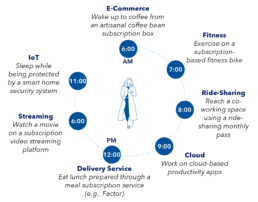
Clearly something works about the subscription model that has people hooked. From the coffee beans people use to make their morning coffee to streaming on a service like Netflix, subscriptions have seemingly taken over a lot of aspects of our life. Clients are moving towards a model of “set it and forget it” to avoid dealing with the hassle of monthly payments by automating it. This behavior is prevalent across the average US consumer that spends $133 monthly on subscriptions ($1,600 annually) and even more prevalent across Gen Z and Millennials with subscription adoption rates of 70% and 12-17 subscriptions (2). Financial companies are taking note and they are launching products to service this segment (e.g., Mastercard acquired Minna Technologies, Square introduced Square Subscriptions and Visa launched Subscription Manager in April 2024). However, with this surge in subscription payment models come unique challenges that impact all players in the ecosystem. Subscribers have an overload of expenses to manage and may feel trapped by these expenses with no easy way to manage them. Businesses have difficulties with payment failures and bottlenecks in collecting payments from clients and card networks and providers.
Exhibit 1. A Day In The Subscription Economy
The Subscription Management Ecosystem
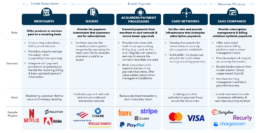
Financial institutions are focused on expanding their subscription management offerings through acquisitions of subscription management software or API integrations. Each player in the payments’ ecosystem plays an important role in facilitating transactions in the subscription economy.
Exhibit 2. Players in the Subscription Management Ecosystem
Key Interactions in the Subscription Management Economy
Exhibit 3. Subscription Management Interactions

The subscription lifecycle typically involves several coordinated steps:
1. Subscription Initiation & Authorization: When a customer subscribes to a service, the merchant (via its payment processor) conducts an initial authorization using the provided card details. This may involve a small test charge or the first billing period’s fee. Under regulations such as PSD2 in Europe, the initial setup often requires strong customer authentication, while subsequent charges can be processed as “merchant-initiated transactions.”
2. Recurring Charge Scheduling: On each billing cycle, the merchant’s system (or its payment processor) automatically submits a charge using the stored payment credentials. The issuer, recognizing the recurring nature of the charge, approves the transaction without the need for reauthentication. The merchant’s ability to maintain current payment details is enhanced by services like the Account Updater.
3. Account Updater & Data Management: As cards are updated (e.g., due to expiration or replacement), the issuer automatically provides new card details to the network’s updater database. The acquirer/processors then query this database and update the merchant’s saved payment token, ensuring that the subscription continues uninterrupted.
4. Involuntary Churn Prevention: If a recurring payment fails (due to issues like insufficient funds), payment processors use retry logic and customer notifications to address the problem before the subscription is canceled. These automated processes help reduce involuntary churn and maintain continuity in the customer relationship.
5. Customer-initiated Changes Or Cancellation: Customers can change or cancel their subscriptions via interfaces provided by the merchant’s system, their bank’s mobile app, or third-party subscription management services. For example, a bank’s integrated tool may display a summary of active subscriptions with an option to cancel with one click. If a customer cancels a subscription through such a tool, the information is relayed to the merchant—either directly or via intermediary systems—ensuring that the subscription is terminated promptly.
6. Lifecycle Management & Customer Retention: Modern subscription management platforms also offer features like pausing a subscription instead of outright cancellation, allowing customers to temporarily suspend a service while maintaining their account. They may also provide personalized retention offers (such as a discount or free trial extension) designed to keep customers engaged. This collaborative approach among merchants, issuers, and processors not only helps reduce churn but also enhances overall customer satisfaction.
How is This Space Evolving?
Customer expectations have shifted as people are looking for more flexible ways to manage their numerous subscriptions in a unified and seamless way. Here is what customers want and expect with regards to subscriptions they use:
Applicable to Customer-Initiated Changes/Cancellation
Flexible Subscription Models: Customers now expect options like pause-and-resume features, customizable plans, and pay-as-you-go options. Over 70% of subscribers desire the ability to pause their subscriptions, highlighting the importance of such options in retaining customers who might otherwise cancel (3).
Applicable to Involuntary Churn Prevention
Rising Expectations For Transaction Support: Merchants now require robust APIs and systems to manage recurring payments seamlessly. For example, Stripe provide comprehensive payment APIs that support various payment methods, ensuring seamless integration with existing platforms and enhancing the overall customer experience. In case of a credit card change, or a failed transaction, clients expect that the payment ecosystem has the guardrails in place to enable the payments and reduce customer churn.
Applicable to Recurring Charge Scheduling
Diverse Payment Options: To cater to a broader customer base, acquirers should support a variety of payment methods, including credit cards, digital wallets, ACH, and mobile payments. Digital wallets, for instance, accounted for 49% of global e-commerce transactions in 2023, a figure projected to rise to 54% by 2026 (4). This is a crucial step to capturing clients where they’re at and enabling fast, seamless payments.
Applicable to Lifecycle Management & Customer Retention
Enhanced Reporting And Analytics: Merchants need detailed insights into payment trends and transaction patterns to increase revenue and reduce churn. Comprehensive reporting tools provide financial insights that are crucial for making informed business decisions like identifying high-performing acquisition channels and subscribers. This enables businesses to deliver an enhanced subscriber experience that increases customer value.
Applicable to Lifecycle Management & Customer Retention
Loyalty Perks And Rewards: Leveraging transaction data to offer insights and loyalty program capabilities can significantly enhance customer retention and engagement. For example, Starbucks utilizes its transaction data to power its loyalty program, providing personalized rewards and promotions that encourage repeat business and strengthen customer relationships.
Applicable to Lifecycle Management & Customer Retention
Ability To Scale & Automate: Lack of scalability inhibits revenue growth, making the right subscription technology stack indispensable. Without this holistic solution, valuable resources and headcount are diverted towards peripheral aspects of the business rather than the core product or service. From onboarding to customized billing, payment processing, and plan management, the success of the subscriber lifecycle hinges on the operational efficiency that a flexible subscription management solution can help you achieve.
What Does This Mean for FIs?
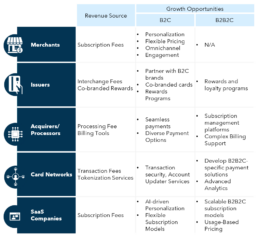
Subscription management economy presents different opportunities for the players in the ecosystem. Merchants and issuers need ways to keep their clients happy through seamless payments, flexible payment models and value added services. Acquirers and card networks need to provide issuers a way to keep their merchants happy and offer them services to manage subscriptions. So in the subscription economy there are two avenues for revenue generation based on where you sit in the ecosystem based on if your goal is to help individuals manage their subscriptions or businesses or if you want to help payment providers. Here are a few examples of ways players are generating revenue:
– Merchants: Maximize LTV through pricing models, retention strategies, and personalized experiences. Spotify offers a family plan and student discounts, increasing its subscription retention rate.
– Issuers: Benefit from interchange fees, co-branded rewards, and fraud prevention. American Express partners with platforms like Netflix to offer cashback on subscriptions for premium cardholders.
– Acquirers/Processors: Generate revenue from processing fees, billing tools, and dispute management. For example, Stripe Billing offers merchants a subscription management API, with pricing based on successful transactions.
– Card Networks: Monetize transactions, tokenization, and data-driven insights. For example, Visa Account Updater (VAU) helps merchants retain customers by automatically updating saved card details when they expire.
– SaaS Companies: Offer subscription management services priced on a recurring or one-time purchase. For example, ChargeBee offers merchants the ability to view reports on subscriber analytics.
Exhibit 3. Growth Opportunities in Subscription Economy
Case Study: Merchant Facing Subscription Management
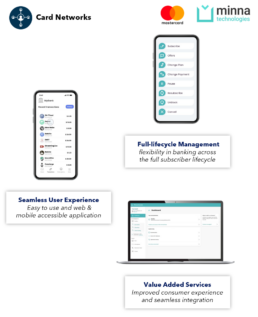
Minna Technologies, recently acquired by MasterCard signifies a significant expansion into subscription management. Minna amassed +120M users, and 22K subscription businesses with partners like Capital One, Lloyds Banking Group, ING, Swedbank etc (1). The focus on B2B2C businesses helps their merchants manage revenue growth, reduce operational cost, increase customer retention and reduce involuntary churn. While Minna’s tools can help reduce unnecessary spending, the platform also facilitates increased engagement with subscription services, which might lead to more spending overall and enhance the subscription experience. This enabled Minna to generate 100+ million in user savings, 85% success rate in bill negotiations, 60% conversion rate to premium subscriptions (5).
Minna’s core features are (6):
Core API Infrastructure: Subscriber API for connecting banks, fintechs, and subscription businesses and single, scalable integration model for all functionality with full API documentation & toolset
Payment Processing Capabilities: Payment rail agnostic system supporting multiple card schemes, ACH, manual payments, 3rd party processors and bank-grade security compliance with PCI 1 standards
Merchant Registry System: Centralized merchant database and proprietary intelligence engine, with transaction identification and enrichment capabilities and payments blocks management
Case Study: Customer Facing Subscription Management
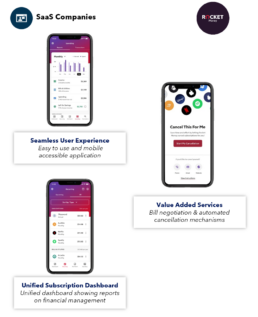
Rocket Money (formerly Truebill) is a multinational neobank and fintech. The company has amassed +5M users and has a 70% month-over-month retention rate. Their business model targets consumers directly through an ironically subscription-based model ($3-$12 per month).1 Additional revenue generating mechanisms are bill negotiation success fees, account management feed and premium features. Rocket Money has proved very successful since it’s creation in 2015. The boast $100+ million in user savings, 85% success rate in bill negotiations, 60% conversion rate to premium subscriptions (7).
Rocket Money’s key features are (8):
Payment Processing: Stripe integration for premium subscription billing, ACH processing for bill payments, secure card tokenization etc.
Transaction Management: Machine learning algorithm for recurring payment detection, Natural Language Processing for transaction categorization, real-time transaction monitoring
Bank integration: Plaid API for bank account connectivity, OAuth 2.0 for secure authentication, end-to-end encryption for financial data
The reason for Rocket Money’s success is because it responds to 2 key trends shaping the industry, 1) the need for flexible subscription models and 2) enhanced reporting and analytics. By allowing customers to manage transactions in a centralized manner, they offer a strong value proposition for reduced spend via bill negotiation and cancellation mechanisms.
Building a Subscription Management Solution
The effectiveness of subscription management hinges on robust technology infrastructure that ensures seamless customer experiences, secure transactions, and operational scalability.
Success in this space hinges on several factors:
– Seamless customer experience and unique value proposition that solves specific pain points for the end-user
– Flexible pricing strategies and offerings in tune with competitor offerings and products
– Robust tech stack and strong retention mechanisms that integrate well within the existing solutions & products
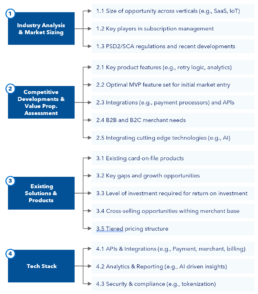
FIs that leverage AI and personalization, offer tiered pricing models, and ensure clients have a satisfactory subscription experience can maximize customer lifetime value (LTV). For example, fintech players like Stripe and Zuora have enabled thousands of businesses to build sustainable subscription models by providing robust billing, revenue recognition, and analytics solutions. To build your subscription management product strategy, it’s important to analyze four key areas:
1. Industry trends analysis to identify areas primed for growth
2. Competitor analysis to create a unique value proposition
3. Existing product suite for card-on-file products
4. Tech stack and required specifications for a new solutions
Exhibit 4. Blueprint to Build Your Subscription Management Product Strategy
Future Outlook, Challenges & Opportunities
As the subscription economy continues to grow, companies are increasingly investing in advanced subscription management capabilities to stay competitive. Here is where the industry is headed:
Increased M&A Activity: This trend is evident in recent mergers and acquisitions, such as Mastercard’s acquisition of Minna Technologies in 2024, which enhanced its position through open banking integrations. Additionally, Zuora has focused on AI-powered billing automation to reduce churn and improve pricing models for both B2B and B2C subscriptions. Square has also entered the market with Square Subscriptions, making it easier for small businesses to manage recurring revenue streams.
New Market Disruptors: New entrants and disruptors are further transforming the landscape. Fintech startups like Rocket Money (formerly Truebill) offer AI-driven subscription tracking and bill negotiation services. Meanwhile, big tech companies such as Apple, Google, and Amazon are expanding their subscription ecosystems with offerings like Apple One and Google Play Pass.
AI-Driven Models: The integration of AI in subscription models is particularly noteworthy, enabling personalized pricing that adjusts fees based on user behavior, predictive churn prevention to proactively engage at-risk customers, and automated payment recovery to minimize revenue loss.
However, the industry also faces challenges, including increased regulatory scrutiny around transparency and cancellation policies, growing concerns about sustainability and ethical practices, and evolving payment preferences such as BNPL and cryptocurrency.
Future Challenges & Opportunities:
– Regulatory Scrutiny: Governments are tightening laws around subscription transparency and cancellation policies. For example, he FTC’s “Click to Cancel” rule (2024) mandates that businesses must allow consumers to cancel subscriptions as easily as they signed up.
– Sustainability & Ethical Concerns: Consumers demand fair pricing, clear cancellation options, and reduced dark-pattern marketing tactics. Companies with non-transparent renewal policies risk customer churn, chargebacks, and negative PR. For example, Apple faced backlash for unclear in-app subscription billing, leading to App Store policy updates.
– Evolving Payment Preferences: The rise of alternative payment methods (e.g., Buy Now, Pay Later, cryptocurrency) is reshaping subscription billing. PayPal’s subscription BNPL feature lets users split recurring payments, appealing to budget-conscious consumers.
To thrive in this evolving landscape, companies must invest in AI-driven optimization, flexible payment methods, and regulatory compliance. By doing so, they will emerge as leaders in the next phase of the subscription economy.
Conclusion
The subscription economy has experienced significant growth with over 7 billion subscriptions globally. This shift towards recurring revenue models presents both opportunities and challenges for businesses and consumers alike. Financial institutions are responding by enhancing their subscription management capabilities to ensure that the subscription experience is enjoyable for all parties and avoids involuntary churn and revenue loss.
To succeed in this evolving landscape, businesses must prioritize flexible subscription models, robust transaction support, and diverse payment options. As customer expectations continue to rise, the ability to scale and automate subscription management processes will be crucial for maximizing customer lifetime value and reducing churn. Ultimately, effective subscription management is not just about handling recurring payments; it’s about delivering a seamless and personalized experience that fosters loyalty and growth. By embracing these trends and technologies, companies can unlock the full potential of the subscription economy and thrive.
- Recurly – 2024 Trends and benchmarks for subscription businesses
- C+R Research – Subscription Service Statistics and Costs
- Recurly – 2024 Trends and benchmarks for subscription businesses
- Clearly Payments – 2024 Payment Methods Report
- Company Website
- Kepler Analysis
- Company Website
- Kepler Analysis