


Introduction
In October 2025, Deloitte conceded that it had failed to follow appropriate AI review and oversight, issuing a government report riddled with fabricated academic citations, false references, and misattributed quotations. It ultimately agreed to refund $440,0001 to the Australian government for that single report.
This is not an isolated lapse; it is a warning shot for what can happen inside any large organization that is scaling AI faster than it is governing it. As U.S. enterprise spending on GenAI surged to $37 billion in 20252, firms have taken on reputational and financial risks due to underdeveloped controls. At the same time, regulators are rapidly tightening the screws. The EU AI Act, now in force as the leading government AI regime, authorizes penalties up to $35 million, and even providing incorrect information alone can trigger fines of $7.5 million.
Exhibit 1. Why AI Governance Matters

Where AI Governance Breaks Down
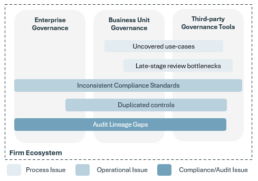
Inside most enterprises, AI is managed in fragments. Model risk teams may maintain controls in one platform, data governance functions in another, and engineering teams in yet another, each with different policies,
dashboards, and definitions of “approved” use. This creates an illusion of control: every tool appears governed in isolation, while obscuring the fact that end‑to‑end AI products traverse multiple business units, clouds, and vendors with no single, consistent control plane. The result is fragmented accountability. No team owns the full chain from data ingestion to model deployment to downstream decisioning, so gaps between policy intent and operational reality are typically discovered only when something has already gone wrong—during a public incident, an internal investigation, an audit finding, or a regulatory exam. In that moment, the lingering question becomes “Why did leadership allow an AI estate of this scale to operate without a unified governance architecture?”.
Exhibit 2. Fragmented Governance
Disconnected silos create compounding risk – from process gaps to audit exposure
Introducing the SDLC-First Governance Model
The SDLC-first governance model represents a fundamental shift in how organizations approach AI governance. Rather than treating governance as a set of controls applied to individual AI tools or platforms, this model embeds governance directly into the software development life cycle itself. At its core, there are three reinforcing principles:
- VENDOR-AGNOSTIC
Governance logic (human-in-the-loop requirements, data minimization, red-team thresholds) should be deliberately decoupled from the underlying tools, allowing teams to swap or add vendors without rewriting the governance model each time.
- FUTURE-PROOF
Controls are built into the development lifecycle from the outset – rather than bolted on after a system is already in production. By tying policies to SDLC milestones, organizations can adapt new policies as regulations without needing to re-engineer every application.
- UNIVERSAL COVERAGE
A single governance framework – articulated as reusable standards, controls, and evidence requirements – should be applied universally across all AI development activities, while business units choose the tools/architectures that best fit their needs.
SDLC-First Governance Model in Practice
The practical implementation of SDLC-first governance embeds structured controls and checkpoints across each phase of the software development lifecycle (SDLC). Rather than treating governance as a post-deployment compliance exercise, the model integrates risk management directly into development workflows.
Each stage introduces automated mechanisms, tooling integrations, and human oversight to ensure AI systems remain compliant, secure, and aligned with organizational policies from design to deployment.
1. CLASSIFICATION
The first step in SDLC-embedded governance is systematically classifying tools based on function, domain, and end-user. Functions may include customer-facing copilots, internal analytics engines, or process automation tools. Domains often reflect regulatory exposure such as healthcare, financial services, HR, or customer support operations. End-user classification differentiates between internal employees, customers, vendors, or partners. Tool classification is typically managed through centralized governance platforms such as ServiceNow AI Registry, OneTrust, or internal AI inventories, enabling organizations to maintain visibility over AI assets across the enterprise.
2. RISK TIERING
Once classified, systems are assigned risk scores based on multiple dimensions including data sensitivity, regulatory exposure, bias potential,
cybersecurity risks, identity access management, and third-party dependencies. For example, a customer-facing chatbot handling personal financial information would receive a higher risk tier than an internal productivity assistant. Risk scoring models are often operationalized through governance platforms such as OneTrust AI Risk Management, Fairly AI, or internal risk scoring frameworks, enabling automated risk profiling at scale.
Exhibit 3. SDLC First Governance Model in Practice
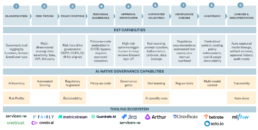
3. POLICY MAPPING
Risk tiers determine the governance requirements applied across the SDLC. High-risk systems may require additional controls such as explainability documentation, model bias testing, or executive approval checkpoints.
Policy mapping frameworks align internal governance standards with regulatory requirements such as GDPR, CCPA, and the EU AI Act, ensuring compliance obligations are operationalized within development workflows
4. TECHNICAL GUARDRAILS
Development platforms enforce governance through policy-as-code guardrails embedded directly within engineering environments. Secure defaults can be implemented through CI/CD pipelines, infrastructure policies, or model deployment controls using tools such as GitHub Actions, Terraform policies, or ML platform governance layers. Developers cannot bypass these guardrails without approved exception workflows.
5. APPROVAL WORKFLOWS
High-risk systems automatically trigger structured approval workflows. These workflows may require human-in-the-loop reviews, security validation, or governance board sign-off before deployment. Integration with platforms such as ServiceNow or Jira ensures governance approvals are embedded within existing engineering ticketing processes.
6. AUTOMATED VALIDATION
During testing, automated validation tools verify that systems comply with governance requirements. Red-teaming platforms test models against vulnerabilities such as prompt injection, data leakage, model hallucination, and jailbreak attacks. Tools such as Lakera, Robust Intelligence, or custom evaluation pipelines enable continuous risk testing prior to deployment.
7. COMPLIANCE CHECKS
Regulatory requirements are incorporated as automated test cases within the validation process. These checks ensure models meet applicable regulatory standards and internal policies before deployment, reducing manual compliance overhead while strengthening regulatory readiness.
8. AI GATEWAY
An AI gateway acts as a centralized control point for routing model requests, enforcing governance policies, monitoring usage, and managing costs across environments. Platforms such as Tetrate, Gloo, or custom API gateways allow organizations to enforce policy enforcement and observability across multiple models and vendors.
9. LINEAGE AND DOCUMENTATION
The deployment process automatically captures model lineage, dataset sources, artifact versions, and approval histories, ensuring end-to-end traceability. Governance dashboards provide real-time visibility into compliance status, enabling audit-ready reporting and simplifying regulatory oversight.
The Value Case: A 3 Horizon Value Framework
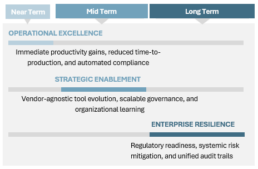
SDLC-first governance creates value across three dimensions that define sustainable AI adoption at scale. This framework (Exhibit 4) illustrates how embedded governance delivers near-term operational gains, mid-term strategic enablement, and long-term enterprise resilience as organizations scale AI across the enterprise.
OPERATIONAL EXCELLENCE (Near-Term)
Organizations report 30–60%4 faster AI deployment cycles when governance and controls are embedded early in the development lifecycle. The shift-left dividend compounds: issues caught at design stage cost hours to
remediate; the same issues covered at deployment cost weeks or months. Automated policy validation replaces manual review cycles, pre-approved templates accelerate project initiation, and continuous compliance monitoring eliminates approval bottlenecks.
STRATEGIC ENABLEMENT (Mid-Term)
Scalability without complexity becomes the strategic differentiator as AI adoption expands. While competitors struggle to govern 50+ models across fragmented tool environments, leaders with SDLC-first governance scale to 200+ models with logarithmic rather than linear governance costs. Policy consistency across geographies, business lines, and development teams enables vendor-agnostic tool evolution and scalable governance. Centralized policy control points allow organizations to adapt quickly to regulatory changes while reducing vendor lock-in and strengthening organizational learning effects.
ENTERPRISE RESILIENCE (Long-Term)
With EU AI Act penalties reaching €35 million or 7% of global revenue4 and regulators expanding AI oversight, governance has shifted from operational concern to board-level risk priority. SDLC-first governance delivers unified audit trails, systematic evidence generation, and demonstrable control consistency embedded directly within development processes. Rather than assembling documentation reactively during audits, organizations maintain continuous audit readiness with system-level visibility across AI systems. As regulators increasingly require AI tools to operate within existing governance frameworks, SDLC-first governance provides the structural foundation for sustainable enterprise AI oversight.
Exhibit 4. A 3-Horizon Impact Framework
SDLC-first governance reduces AI risk by addressing failure modes structurally rather than reactively, by:
ELIMINATING CONTROL FRAGMENTATION
Tool-level governance fragments accountability across platforms, teams, and vendors, creating inconsistent enforcement. Regulators increasingly evaluate AI systems end-to-end, not by tool boundaries. . Centralizing governance at SDLC level establishes a single control plane for policy enforcement, evidence capture, and accountability across design, build, test, deploy, and operate.
PREVENTING LATE-STAGE GOVERNANCE FAILURES
Industry data consistently shows that defects discovered late are exponentially more expensive to remediate. IBM’s Systems Sciences Institute estimates issues cost 30–100×5 more to fix in production than during design. By shifting governance “left,” SDLC-first models detect policy, data, and risk issues before deployment, preventing release delays and regulatory remediation
STRENGTHENING ENTERPRISE ACCOUNTABILITY
Embedding governance into the SDLC clarifies ownership: risk is managed by design, not negotiated at release. This aligns with regulators’ emphasis on demonstrable, system-level accountability (EU AI Act; SEC AI oversight priorities).
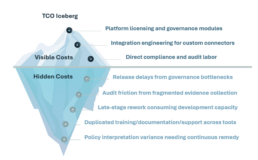
Organizations systematically underestimate tool-level governance costs by focusing on visible platform licensing while missing substantial hidden expenditures.
SDLC-first governance shifts spend structurally:
- From repeated tool-level investments → shared lifecycle controls
- From reactive remediation → preventive, design-stage enforcement
Over time, this reduces remediation, audit, and integration costs while stabilizing governance spend as AI scales.
Exhibit 5. Visible vs. Hidden Costs of Tool-Level Governance
The Strategic Inflection Point
AI governance at scale presents a strategic inflection point for enterprises across industries. Tool-level governance can be practical in early experimentation, isolated deployments or environments with a small number of low-risk models. It offers speed and minimal upfront investment. However, as organizations expand AI across products, teams, vendors and geographies, fragmented controls introduce duplicated effort, inconsistent enforcement, audit friction and growing regulatory exposure. What works at five models rarely works at fifty.
SDLC-first governance addresses this structural challenge by embedding oversight directly into the software development lifecycle. Instead of layering controls onto individual tools, it creates a unified control plane-standardizing classification, risk tiering, policy mapping, validation, documentation, and monitoring across the full lifecycle. Governance becomes proactive rather than reactive, automated rather than manual, and systemic rather than siloed.
For enterprise leaders, the decision is not whether governance is necessary, but where it should live. Embedding governance upstream ensures scalability, resilience and sustained innovation without proportional growth in risk or cost. The call to action is clear: design governance as architecture and not an afterthought. Move from fragmented tool oversight to lifecycle-embedded control before AI complexity compounds faster than your ability to manage it.